adfield, Author at Citizen Machinery - Page 2 of 18
Comprehensive upgrade of popular Citizen lathe
The seventh generation of the Citizen Miyano BNJ-51SY turn-milling centre has been re-engineered from the ground up to offer superior rigidity, expanded machining capabilities and advanced features for efficient unmanned operation.
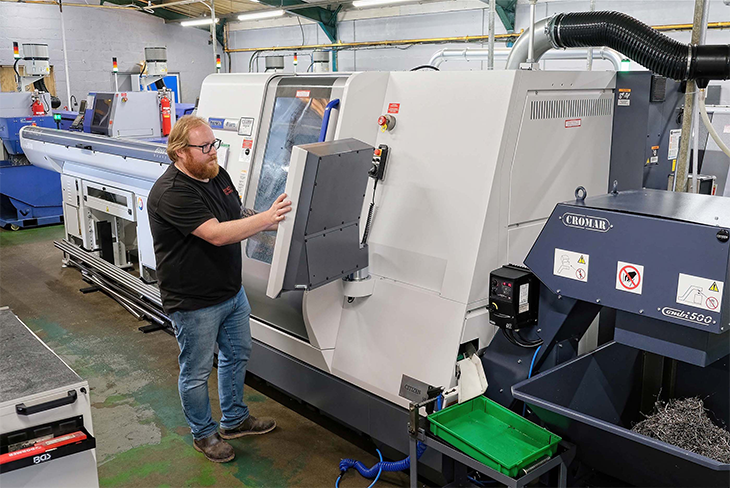
The Citizen Miyano BNJ-51SY turn-milling centre has seen a significant increase in machining functionality following an extensive reconfiguration. Availability in Britain and Ireland is through Citizen Machinery UK.
The innovative, CNC, fixed-head, automatic barfed lathe has been re-engineered from the ground up to address the demands of modern manufacturing. It offers superior rigidity, expanded machining capabilities and advanced features designed for efficient unmanned operation. It also represents a major advance in Citizen’s commitment to its EcoBalance machine philosophy, focusing on sustainability.
Central to the BNJ-51SY’s upgrade is an improved cast structure that dramatically increases machine rigidity and hence tool life, as well as minimising thermal movement, ensuring the lathe maintains high-precision performance even under demanding machining conditions.
The machine is equipped with two spindles, both capable of reaching a speed of 5,000 rpm. A key upgrade is the expanded machining area at the sub spindle side, which now allows a 51 mm diameter chuck to be mounted on the opposed spindle, matching the main spindle’s capacity. Identical chuck diameter on both sides significantly broadens the range of workpieces that can be processed in a single setup and allows a seamless, integrated approach to complex workpiece production for greater versatility and efficiency in the workshop.
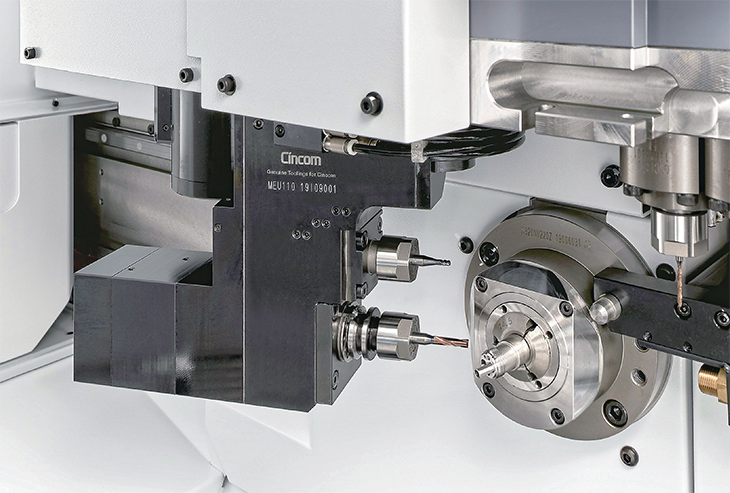
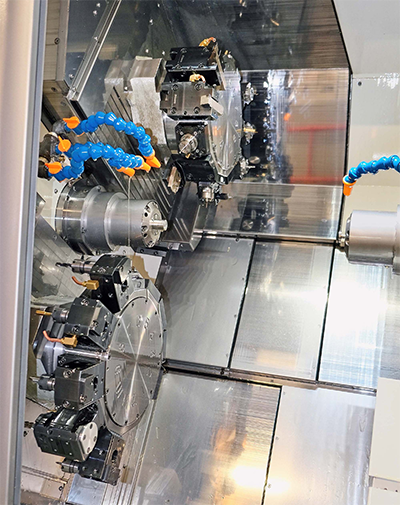
The machining area of the BNJ-51SY, which is now has LFV (low frequency vibration) technology in the FANUC 0i-TF Plus control.
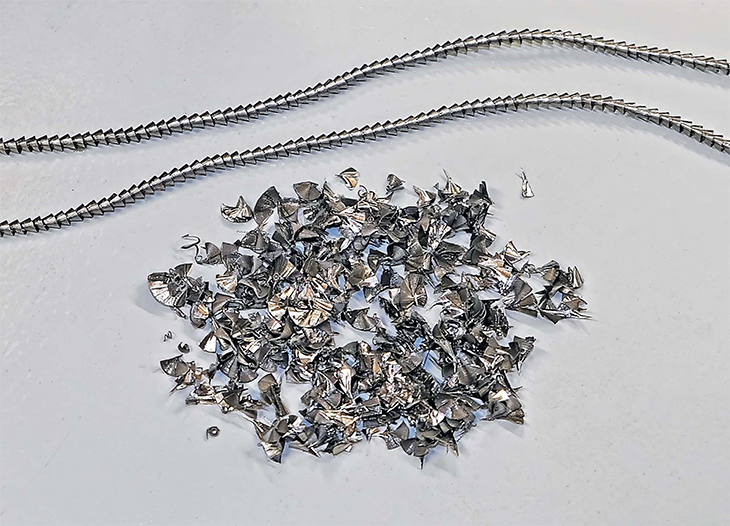
A notable addition to the new, seventh-generation BNJ-51SY is the integration of Citizen’s proprietary LFV (low frequency vibration) technology. The function reduces swarf-related issues by breaking up the ribbons generated when cutting some materials into smaller, manageable fragments. Furthermore, the lathe now has simultaneous four-axis control, meaning that LFV can be used in the X and Z axes on both the main spindle and the sub spindle at the same time, allowing more convenient division of front-end and reverse-end cutting operations.
The flexible, multi-tasking machine features two turrets, with 12 live tool stations in the main turret and eight live tool stations in the second turret. The 3-axis main turret benefits from vertical Y-axis movement, while torque has been raised to 25 Nm on the second turret to match the first, ensuring stable and powerful cutting. The distance between the work spindles has been increased by nearly one-half to 825 mm, greatly expanding the size of component that can be produced. Rapid feed rates are fast – 24 m/min for the X1, X2, Z1, Z2 axes and 18 m/min for Y1 – ensuring minimal non-cutting times.
The machine is controlled by a FANUC 0i-TF Plus CNC system with a 10.4-inch colour LCD screen. Standard NC functions include collision detection, automatic power-off, a tool offset capacity of 128 pairs, and various interpolation and turning, milling and drilling functions. LFV modes, geometry support and a power consumption monitor are included.
Optional features like a spindle brake, an in-machine unloader for automated workpiece transfer, a chip conveyor, and various air blasts and detectors ensure the BNJ-51SY can be customised to suit a wide array of specific manufacturing requirements.
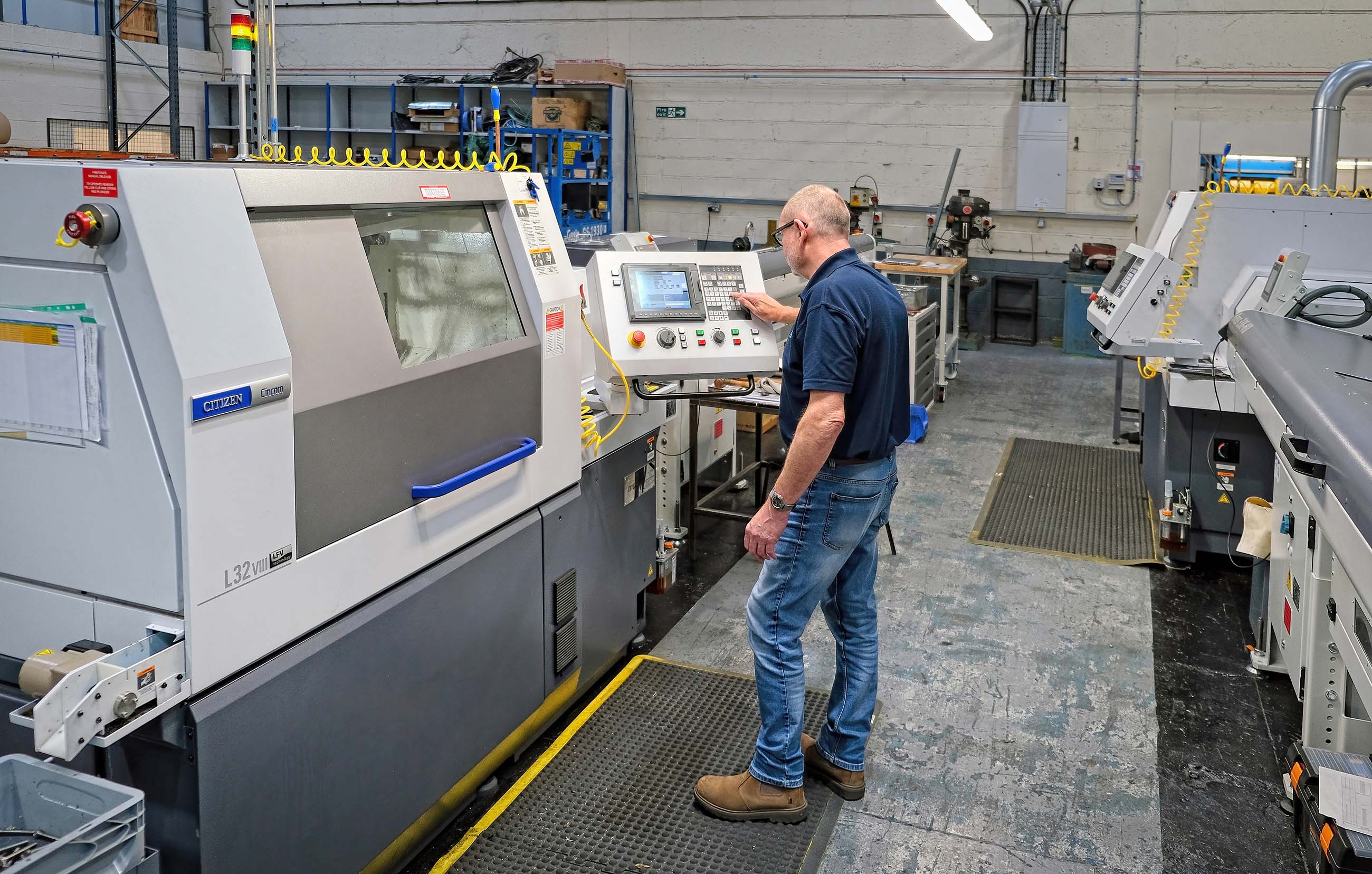
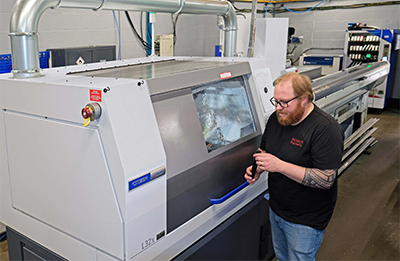
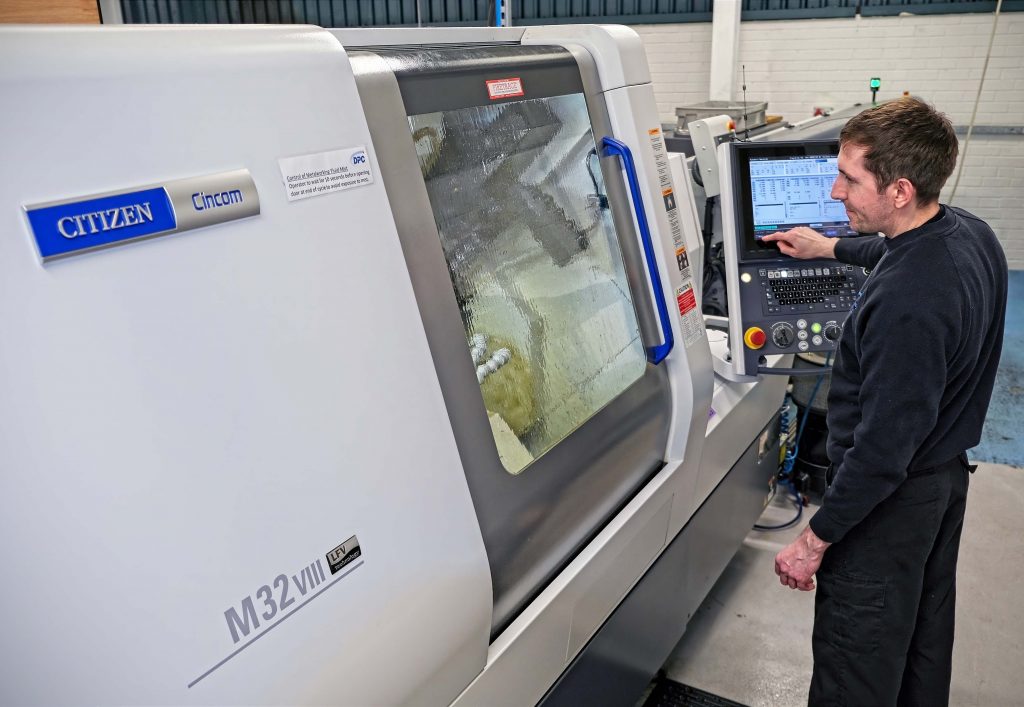
John Cable at the control of the Citizen Cincom L32-XIILFV sliding-head lathe with B-axis live tool carrier, which was delivered to C&M’s Maldon factory in June 2025. An identical machine was installed two years previously.
With electricity bills, raw material costs and company taxes at record highs, coupled with an absence of anyone in Government to champion the interests of SMEs (small and medium-sized enterprises) in the UK, manufacturers like 13-person subcontract turn-milling subcontractor C&M Precision are looking to high technology to maintain profitability.
That is why the firm’s owner and managing director, John Cable, continues to buy Japanese-built lathes from Citizen Machinery UK. Modern versions have proprietary LFV (low frequency vibration) chip-breaking software in the operating system of the controls, enabling a manufacturer’s earnings to be maximised by ensuring the reliable production of superior, high-added-value components, while reducing scrap rates to virtually zero.
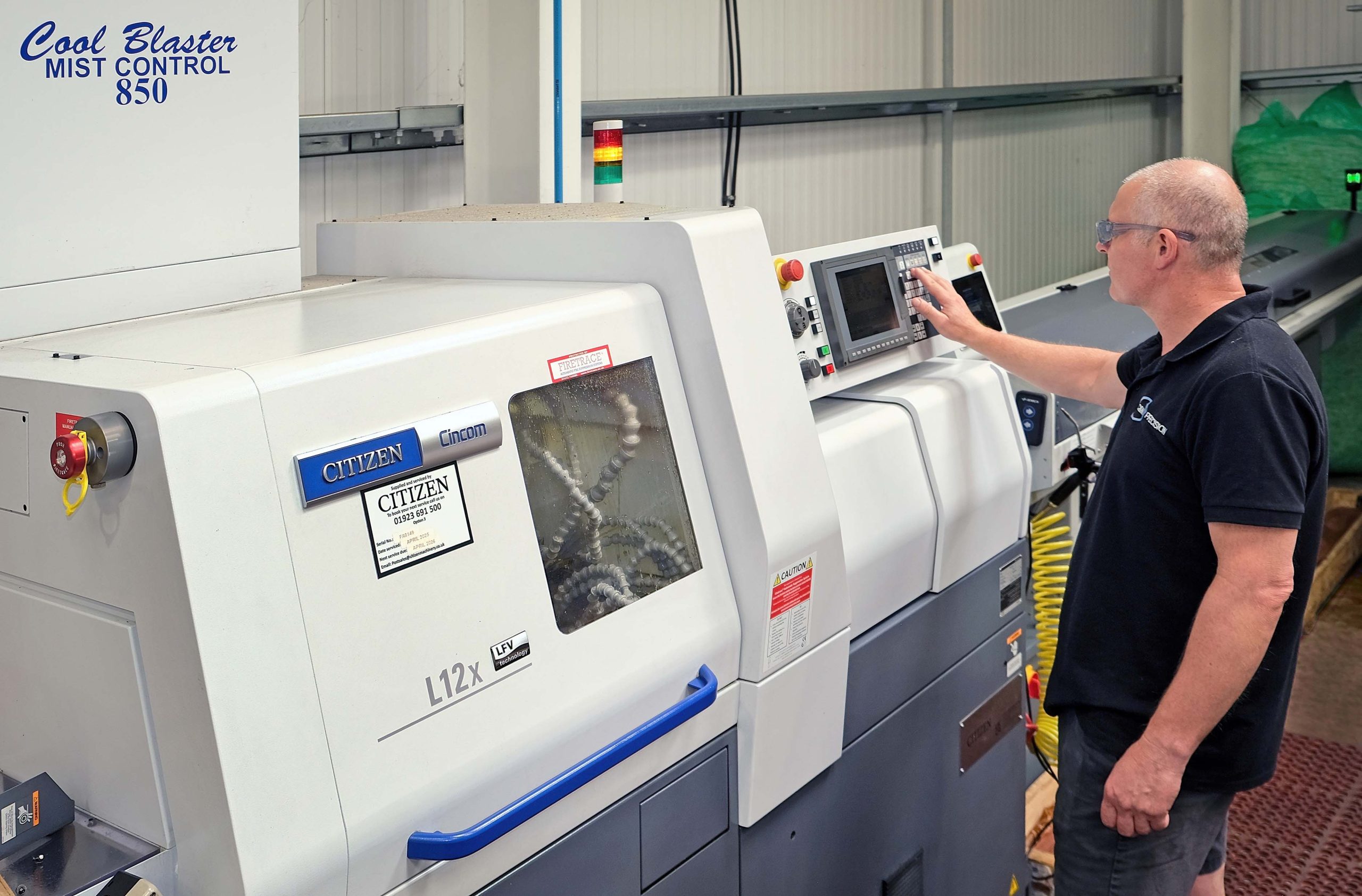
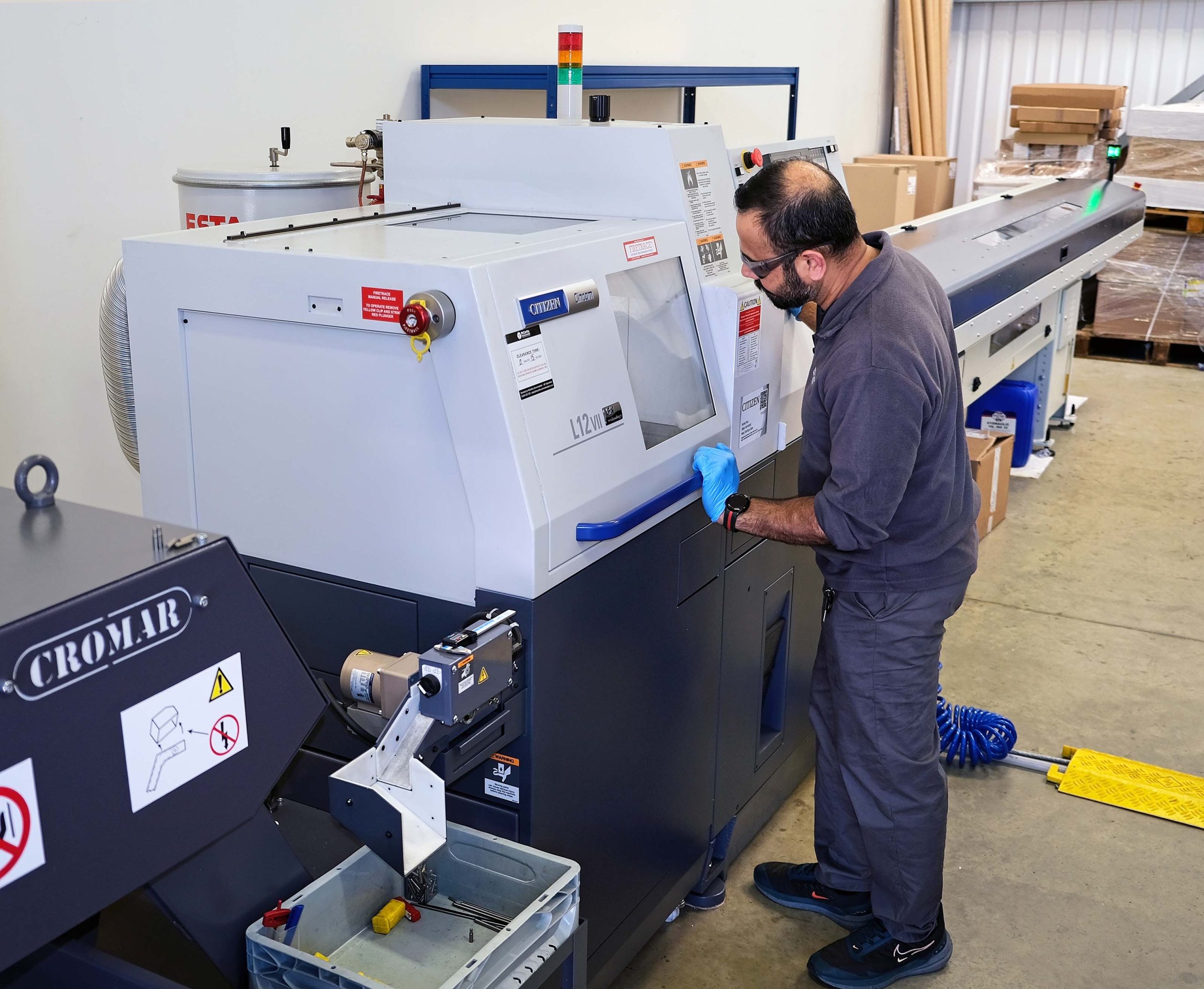
A view of the compact working area of the Cincom L12-XLFV.
The software, which works at both the main and sub spindles, synchronises servo axis infeed with work spindle rotation, oscillating the former to create periods of air-cutting, measured in microseconds, to break stringy swarf normally generated by malleable materials into chips of manageable size. The programmable function is markedly different from and a significant improvement over conventional pecking macros and dwells. Mode 1 is for turning of outer or inner diameters and for grooving; mode 2 is for operations that require high peripheral speed, such as fine machining or deep, small-diameter drilling; while mode 3 is specifically for threading.
Mr Cable commented, “We were an early adopter of this technology, buying our first L20-VIIILFV Cincom sliding-head lathe in 2017, the first year the function was available on Citizen turn-mill centres in Europe.
“I would never buy another lathe without LFV. We only source machines from Citizen and nearly half of our 13 lathes on the shop floor have the chip-breaking functionality, five Cincoms and a fixed-head Miyano.”
Four of the lathes have been purchased within the past two years, representing an investment of nearly £750,000, indicating Mr Cable’s desire to maximise C&M’s use of the technology and to regularly modernise the production facility in Maldon, Essex.
LFV-enabled lathes are invaluable for processing metals of high malleability like OFHC (oxygen-free high conductivity) copper, a grade that is more than 99.99% pure. The chip-breaking function is also used extensively when machining HE9 aluminium, which is known to be sticky and require close attention to chip control and tool sharpness to obtain best results.
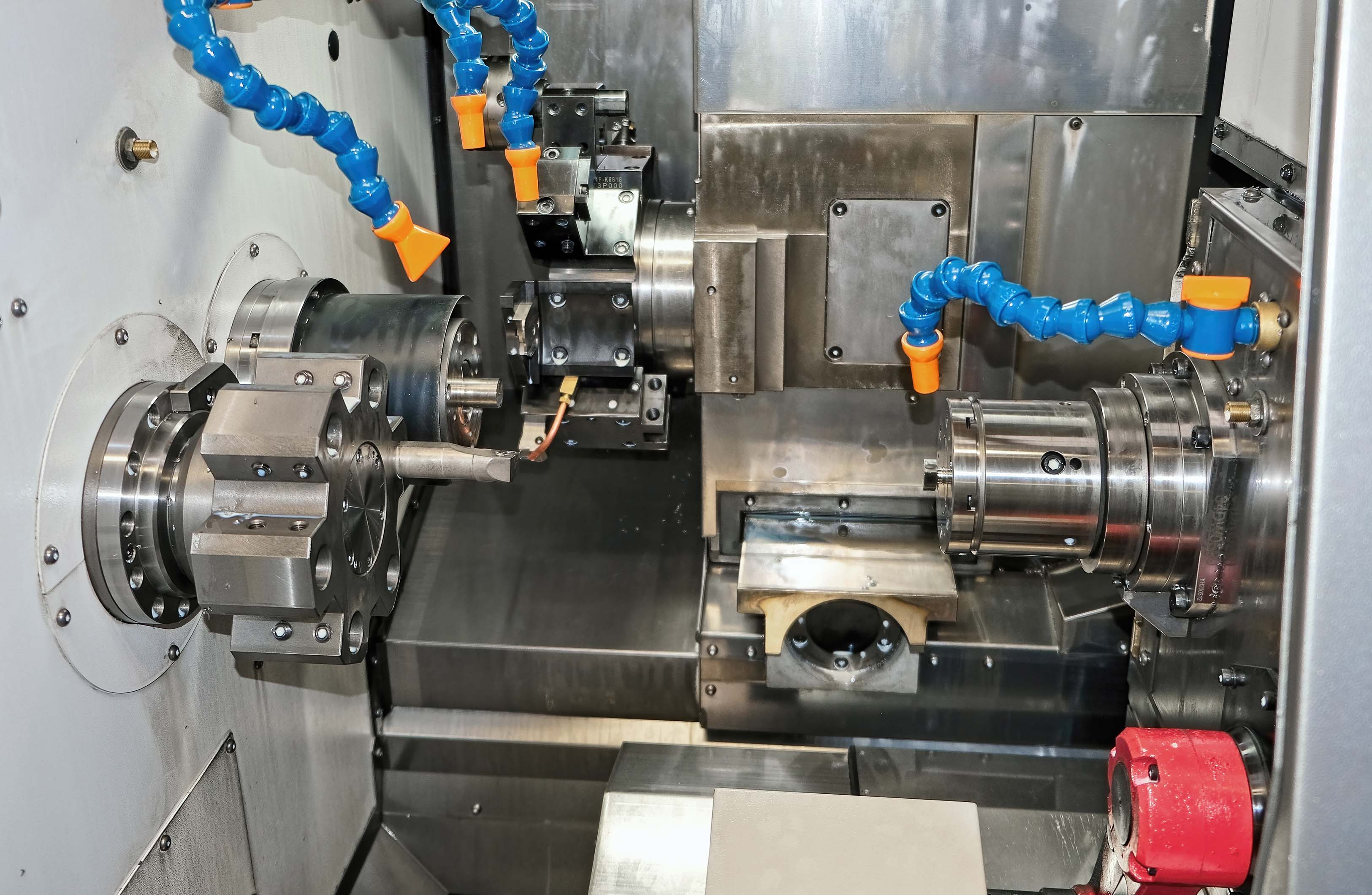
Working area of the ANX 10-axis CNC lathe, which is able to perform superimposed machining with three tools in cut simultaneously.
Other jobs regularly fulfilled by C&M involve machining of plastics, which are notorious for generating bird’s nests when turned, drilled or thread-cut. One contract involves machining 3,600 metres of acetal bar annually. Another, in a similar material for the production of a long medical device, would be impossible to tackle without LFV, according to Mr Cable.
He continued, “LFV makes mincemeat of all these difficult jobs – it really works, even on nickel alloys, and is useful for both roughing and finishing. Naturally, the brief periods when the tool is lifted clear of the surface of the bar reduces material removal rate, but only slightly.
“It is more than offset by preventing long swarf from damaging a component or tool, by avoiding having to stop the machine to clear tangled swarf, and by having all good parts in the container at the end of a long period of unattended running, including overnight.”
Mr Cable explained that LFV is programmable, G-codes being used to switch it on or off as required during a cycle. If processing materials such as brass or free-cutting alloys of aluminium or steel, it is not used at all. When it is used, it is adjustable. Citizen’s offline Alkart Wizard conversational programming interface, which guides users through the creation of a part program, recommends from its built-in code library a certain number of LFV pulses per revolution of the bar, according to its diameter and the type of material.
C&M staff then use their knowledge and experience to lower the pulse rate, often by as much as 50% to 65%, creating chips of slightly longer but still acceptable length, while at the same time lowering the proportion of air cutting in a cycle to increase productivity. The lower frequency oscillations also result in quieter metal cutting and minimise the stress on the tooling.
Being inspected on C&M’s new OGP Smartscope measuring machine is a 25 mm diameter OFHC copper anode. Machined on a Cincom L32-XIILFV, it has 12 longitudinal, equispaced slots with a 14-micron width tolerance machined along the bore. The distance from the bottom of opposing slots must be held to within 25 microns.
The most recent Citizen Cincom to be delivered to the Maldon factory, in June 2025, was a Cincom L32-XIILFV sliding-head lathe of nominal 32 mm bar capacity, with B-axis live tool carrier and long parts collection unit. An almost identical machine was installed two years previously. As an indication of the precision attainable on this machining platform, a 25 mm diameter OFHC copper anode produced on it has 12 longitudinal, equispaced slots machined in the bore to a width tolerance of 14 microns. The distance from the bottom of opposing slots must be held to a limit tolerance of 14.415 mm / 14.440 mm.
Notable also is that the B-axis option on these machines is essential for milling an angled flat on a titanium ball joint, a feature that is impossible to realise on other Citizen lathes at C&M and would have necessitated a second operation to be carried out. Mr Cable tends to buy the most capable variant of all Citizen lathes to make sure there is maximum capability on the shop floor, so these lathes are equipped with a kit that allows feeding of oversize bar stock up to 38 mm.
The Cincom installed in March last year was an 8-axis CNC model, an L12-XLFV.
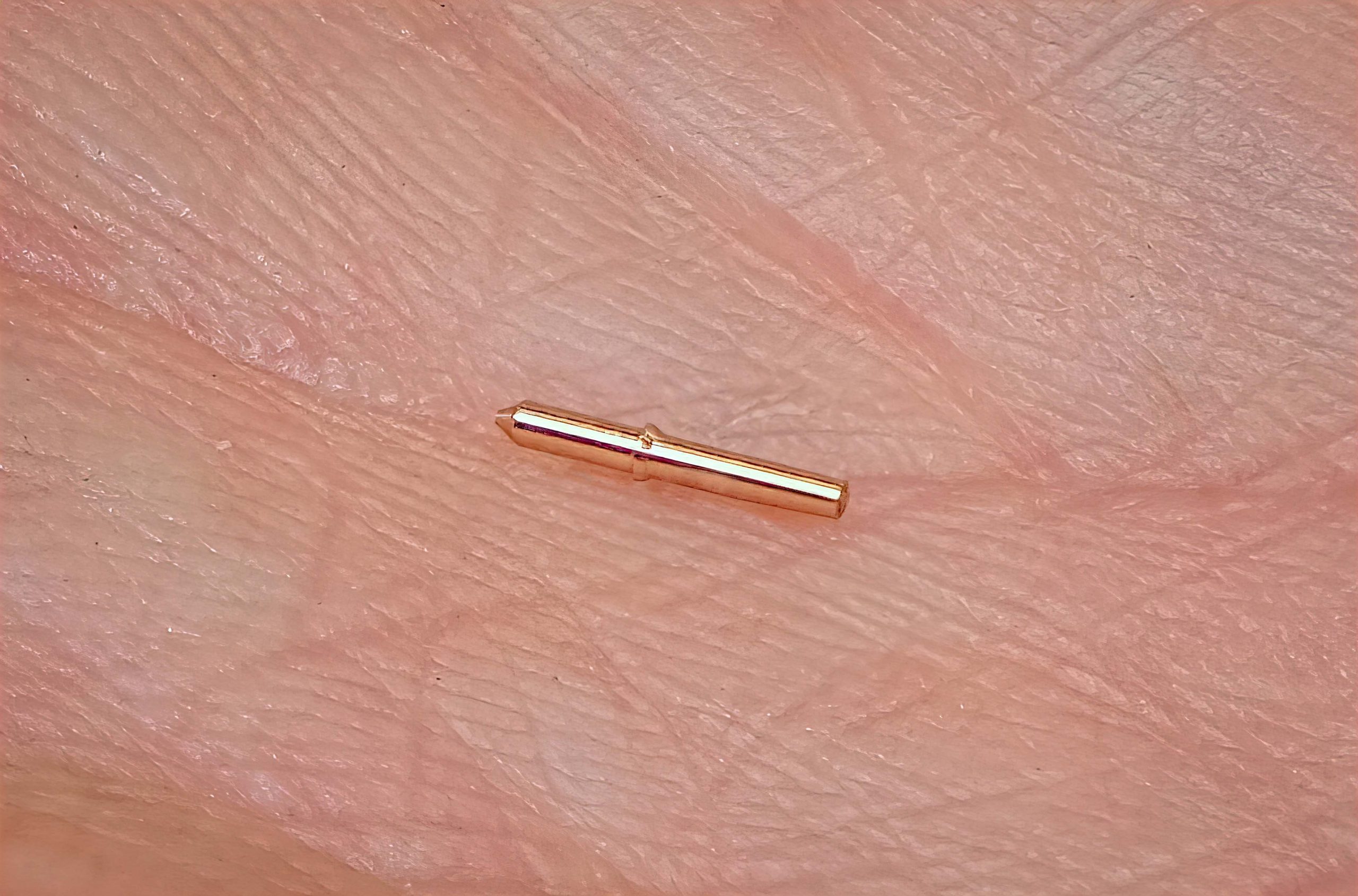
A little over a year before its arrival, a 12 mm capacity Cincom L12-XLFV with a long parts unit and a Y2 axis on the counter-spindle for additional back working opportunities was bought, joining an earlier, similar machine installed in 2019. These lathes have revolutionised the production of smaller parts. An example is the machining of connector contacts from beryllium-copper bar. Each is 7.4 mm long, less than one millimetre in diameter which is turned to ± 12.7 microns, and has two 0.2 mm wide slots spaced 180 degrees apart plus a 0.51 mm diameter, 2.3 mm long hole drilled axially into one end.
When C&M was visited, the L12-XLFV was machining connector contacts from beryllium-copper bar. It is 7.4 mm long, less than one millimetre in diameter turned to ± 12.7 microns, and has two 0.2 mm wide slots spaced 180 degrees apart plus a 0.51 mm diameter, 2.3 mm long hole drilled axially into one end.
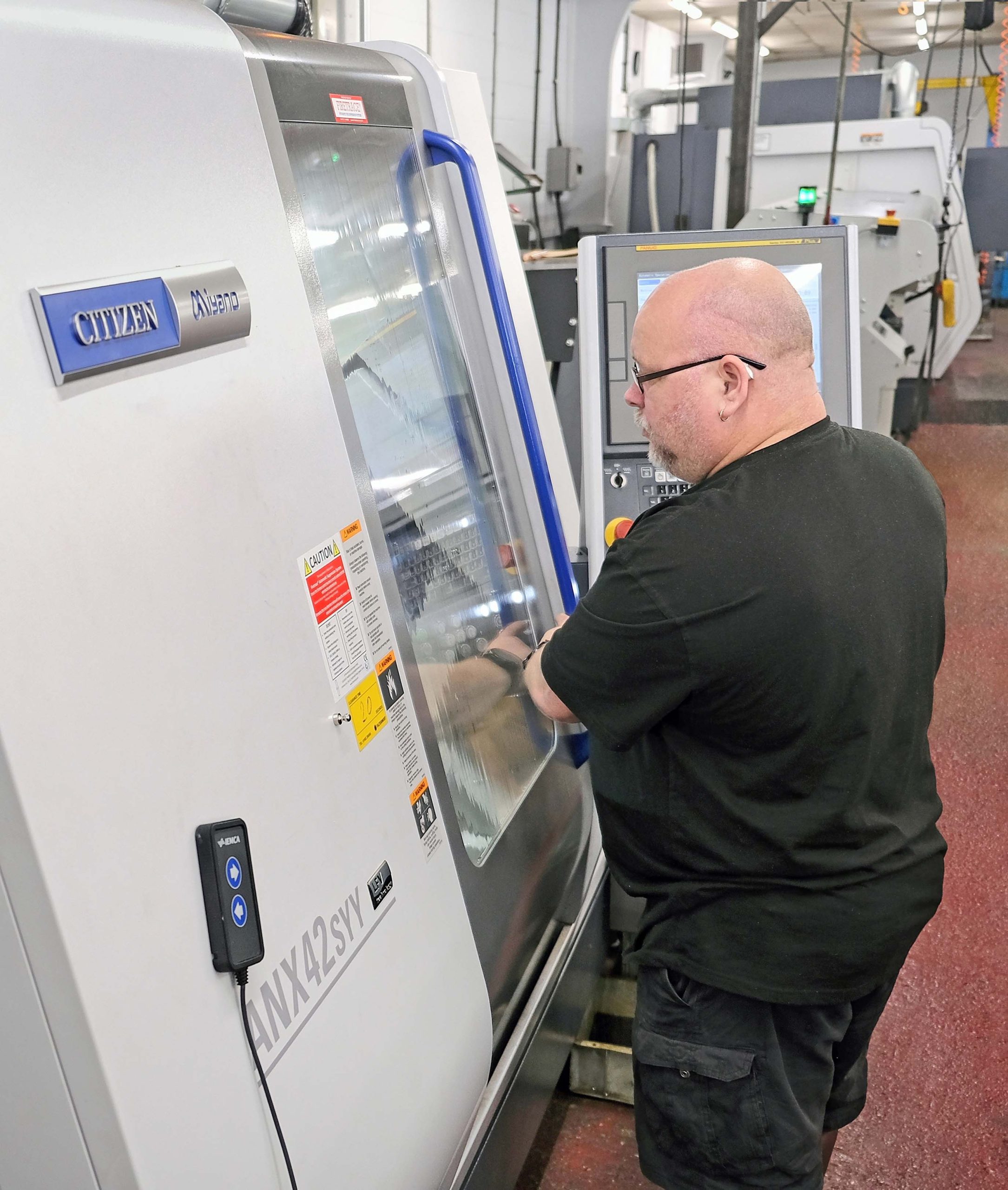
The Miyano ANX-42SYY, which has Y-axis motion on both tool turrets, is the latest Citizen fixed-head lathe to be installed at C&M.
The other recently-installed Citizen lathe is a fixed-head, twin-turret, twin-spindle Miyano ANX-42SYY, which in December 2024 joined two larger capacity, double Y-axis Miyanos, both BNE-65MYY models. Again, the number denotes the nominal bar capacity in millimetres. The ANX model, a 10-axis CNC lathe, was the first of Citizen’s fixed-head lathes to have LFV. Notable features are its ability to perform 3-axis simultaneous cycles, double Y-axis cutting, and superimposed machining with three tools in cut at the same time due to X-axis movement of the sub spindle.
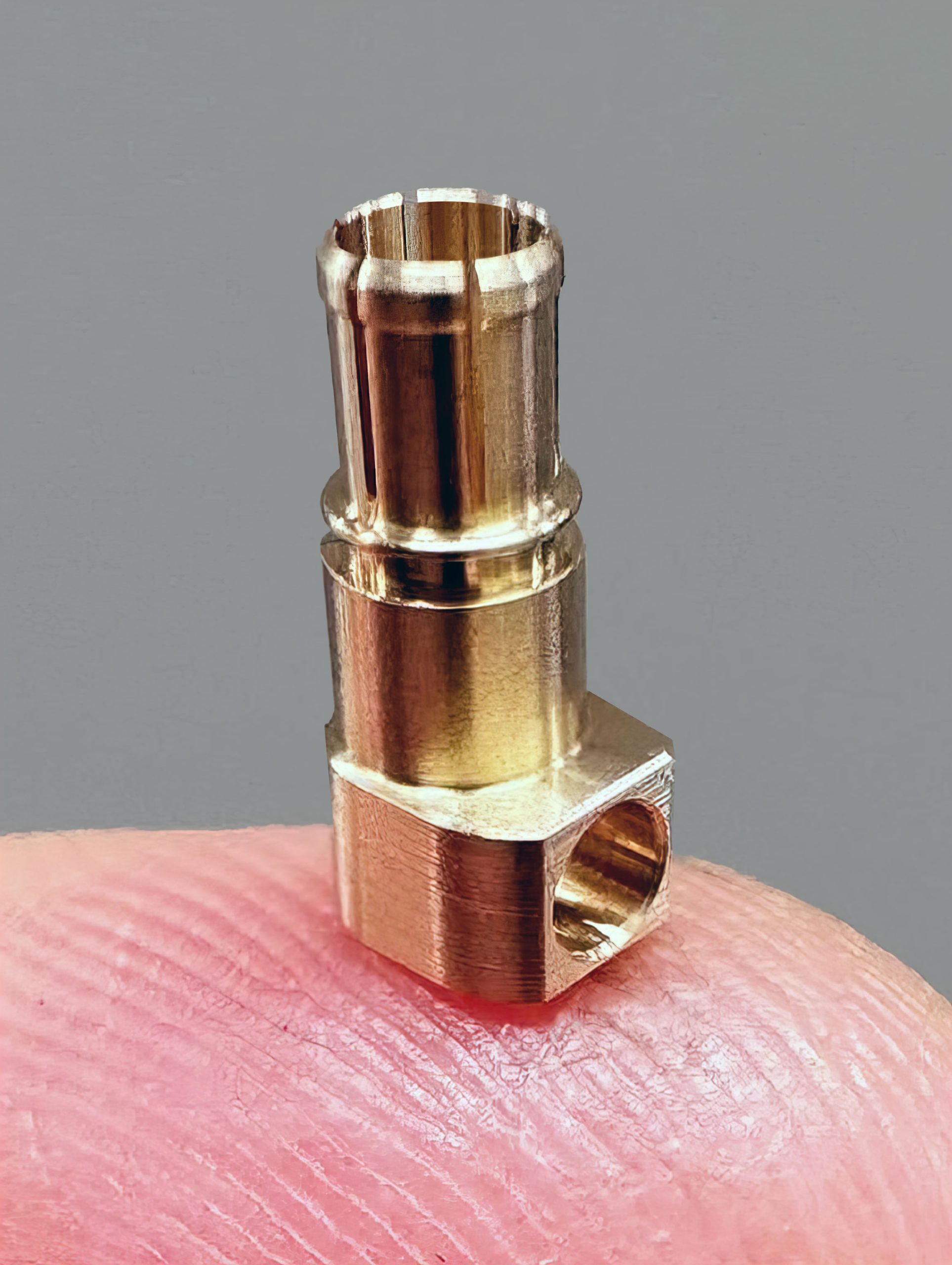
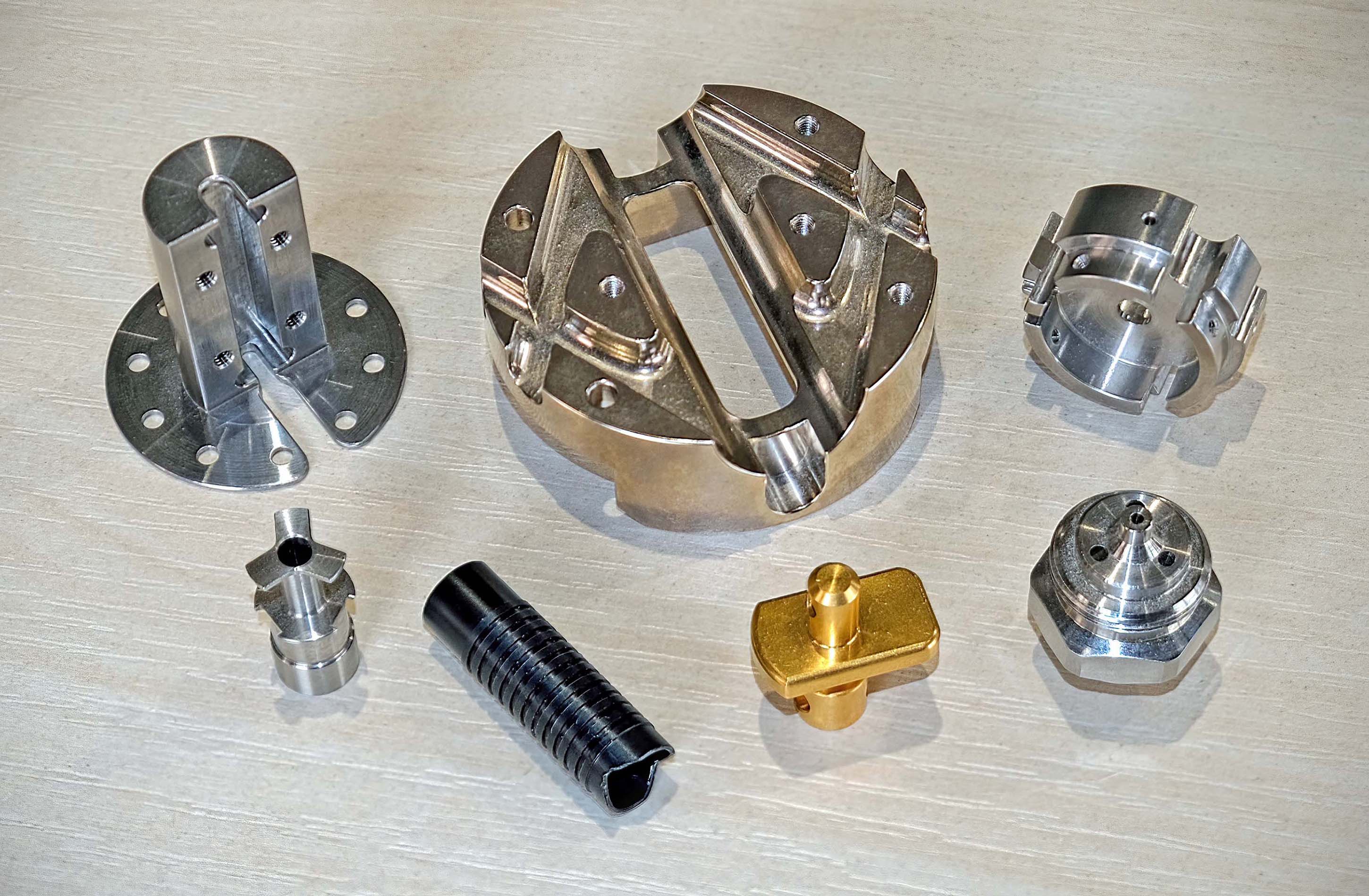
A typical component produced on one of the smaller capacity Citizen Cincom lathes at C&M.
Leon Rawlinson, who joined C&M a couple of years ago as production manager, brought with him extensive experience of turning. He introduced the subcontractor to single-point broaching of hex and Torx features, instead of wobble broaching them. The former, faster method exploits the high power and Y-axis capability of the Miyanos, producing a better surface finish while eliminating the considerable stresses imparted to the lathe structure by wobble broaching. The change in manufacturing process has helped the subcontractor to win new business for the fixed-head turning centres.
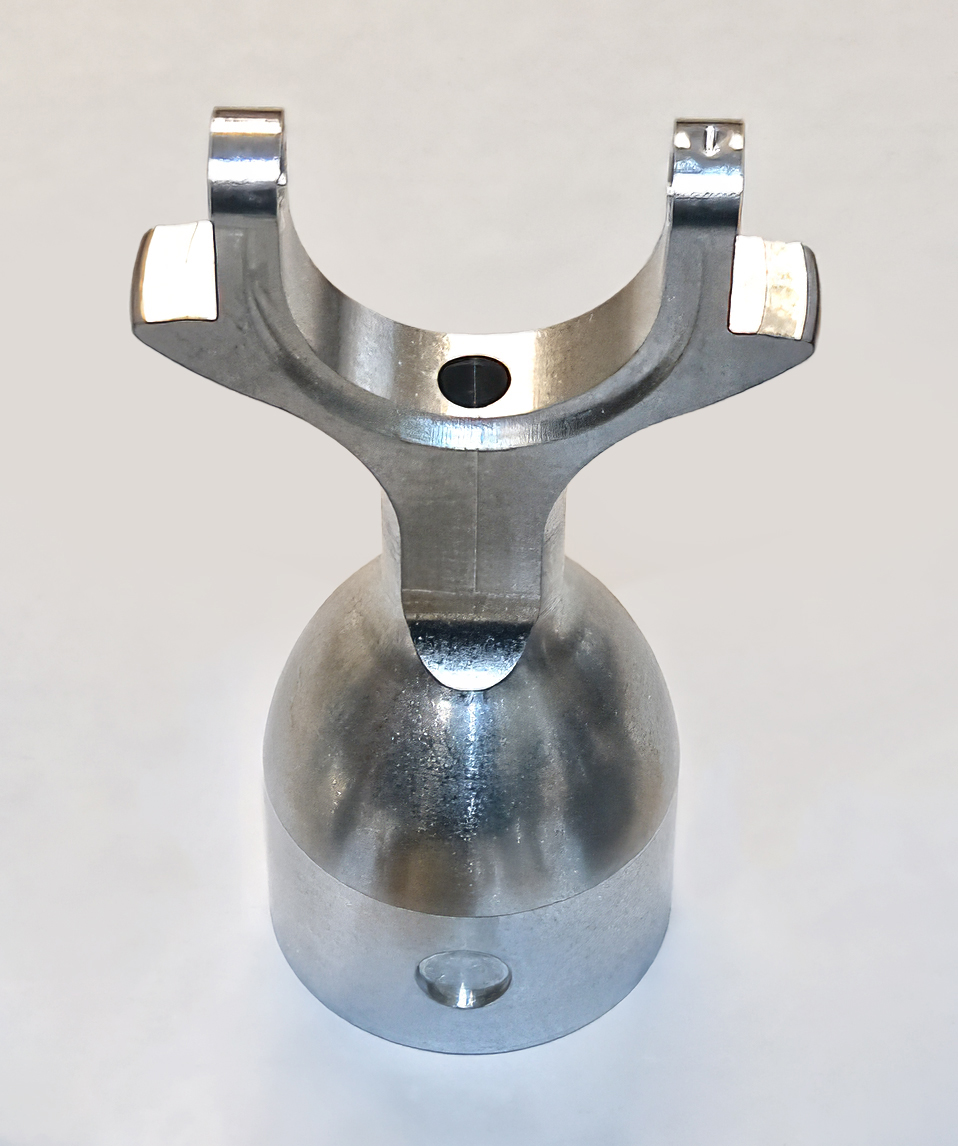
This aluminium broadcasting microphone part illustrates why use of the Y-axis turrets on the Miyanos is essential.
All this modern technology, which includes an ability to remove the guide bush on current Cincom models so that less expensive bar can be used and stock wastage reduced when machining relatively short parts, helps to mitigate the increasingly high cost of running a subcontract business these days. There are additional opportunities to increase turnover and profitability, for example by producing prismatic parts that require no rotational machining at all on the 13 turn-mill centres. Mr Cable says this is frequently done in the Maldon factory, as a bar-fed turn-mill lathe will always produce such components at a lower cost than is possible on a machining centre, so new business may be won this way.
However, despite all the technological progress, there is an ongoing issue of a lack of Government support for manufacturing. Mr Cable is a vocal campaigner on representation for the sector in Westminster and met with Rt Hon Sir John Whittingdale OBE MP at the subcontractor’s factory on 11th July 2025. He was presented with tangible examples of challenges at C&M, like escalating energy costs, and four days later the MP for the Maldon constituency raised the issue of industrial electricity prices in the House of Commons.
C&M Precision had thus successfully elevated the issue to parliamentary attention. However, the initiative is not merely about electricity prices nor one company’s struggles. It is a powerful demonstration of how targeted dialogue with policymakers can spark a wider conversation and encourage Governmental bodies to review and address systemic issues impacting the UK’s vital SME manufacturing base. Mr Cable eagerly awaits further feedback.
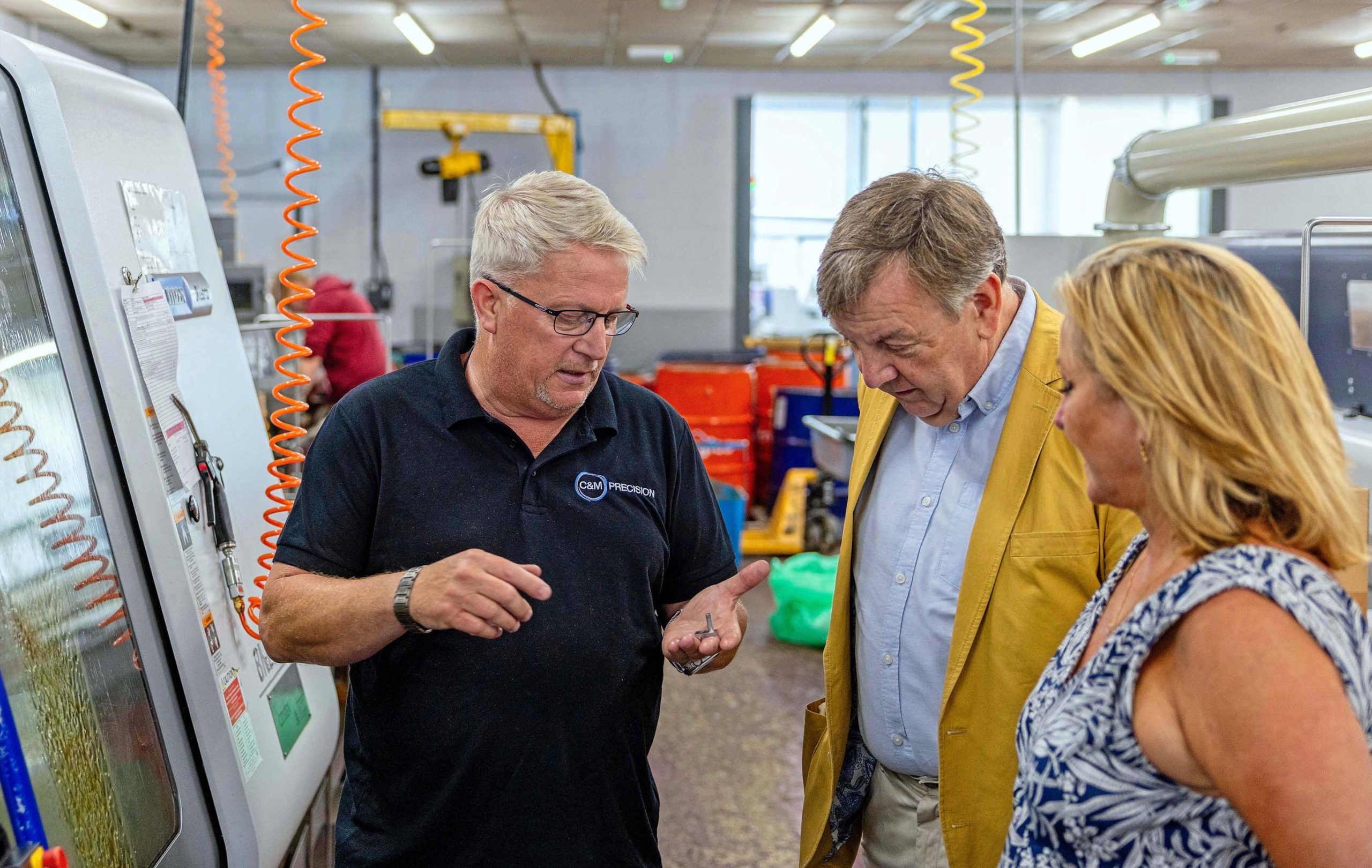
John Cable (left) speaking with Rt Hon Sir John Whittingdale OBE, Conservative MP for the Maldon constituency, when he visited C&M Precision in July 2025. Visiting on the same day was Andrea Wilson, a director of Hone-All Precision, who is equally vocal about the need for a Government tsar to look after the interests of SMEs.
Sliding-head lathe cuts tungsten bar 12 hours a day
Ten percent year-on-year growth in global sales since the start of the decade, and similar success confidently expected in the coming years, has prompted First Light Lamps to replace some of the 1980s- and 1990s-built turning machines at its Ely, Cambridgeshire factory with two new models that are more reliable, capable, productive and accurate. Producing 120,000 xenon and krypton lamps annually for laser and IPL (intense pulsed light) systems, used widely for medical and industrial applications, the company is the leading manufacturer of its type in Europe and among the three largest in the world.
First Light Lamps produces 120,000 xenon and krypton lamps annually for laser and IPL (intense pulsed light) systems.
Two legacy Miyano fixed-head lathes and a Cincom sliding-head turning centre have been removed to make room for two modern Cincoms, which were delivered in May this year (2025) by Citizen Machinery UK. The lathes will not only machine all the electrodes and connectors previously produced by the three old Citizen lathes but, when they are fully on-stream, will also allow the 10 percent of the company’s components currently being subcontracted out to be manufactured in-house. It will be a considerable financial saving and will also give the factory complete autonomy over its parts machining and lamp assembly.
The Cincom L12-VIILFV at Ely is devoted to the production of electrodes from lanthanated tungsten bar.
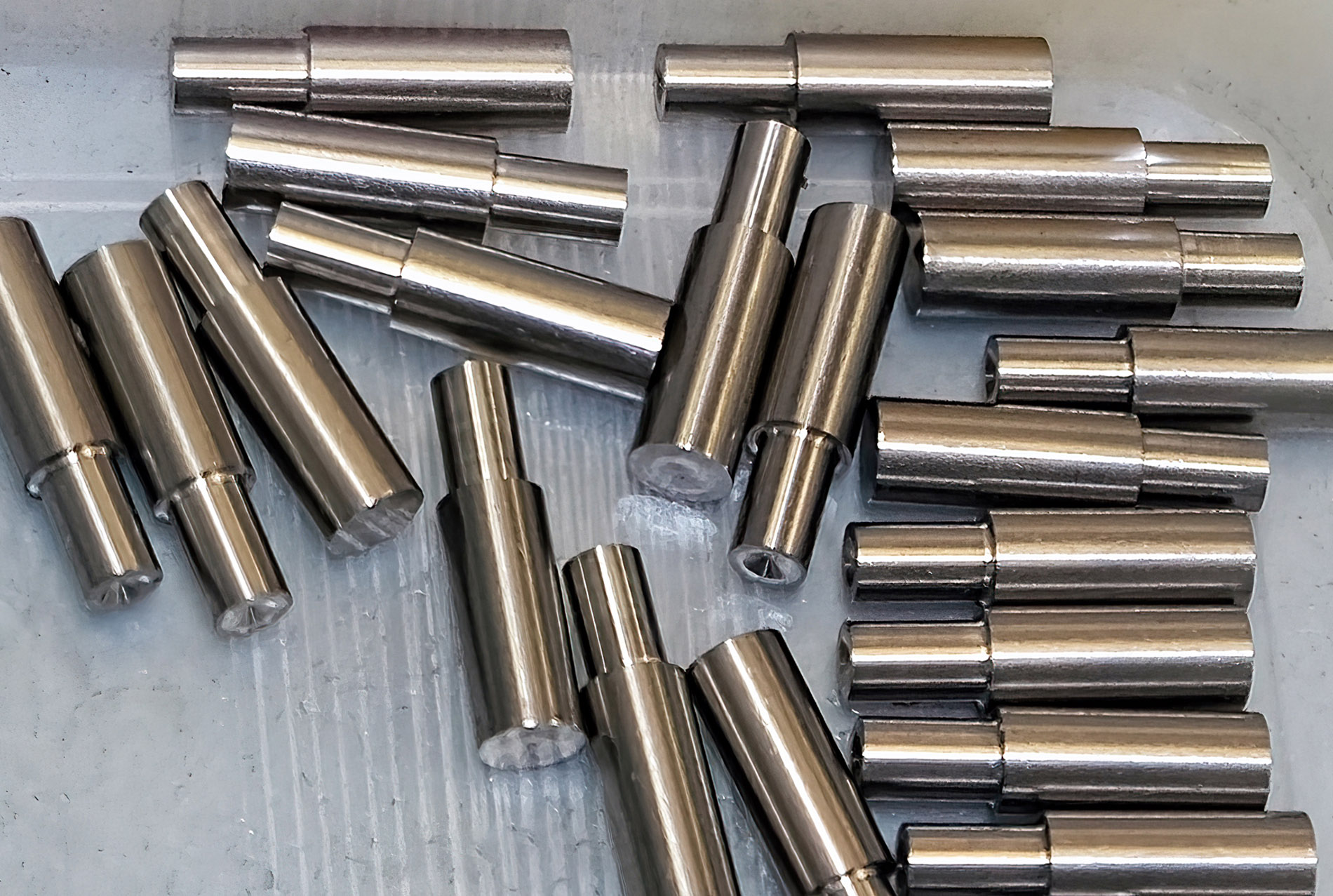
The smaller of the two new Cincoms, a 12 mm bar capacity L12-VIILFV, is devoted to machining lamp electrodes from lanthanated tungsten bar, 1.5 to 2 metres long, of various diameters between 2.8 mm and 9.5 mm. The job was previously done by two of the old Miyano fixed-head lathes, which were purchased second-hand in 2004 when First Light Lamps was founded. It is notable that, being of 34 mm bar capacity, they were deliberately over-specified in terms of size to gain the rigidity of a bigger production platform for machining the tough material.
Paul Walker, director and co-owner of First Light Lamps.
Paul Walker, a director of the lamp manufacturing firm said, “We were initially sceptical that a sliding-head lathe, especially one of 12 mm capacity, would be robust enough to machine tungsten all day long.
“However, Citizen Machinery assured us that this model would be capable of doing so and cut demo parts using our tungsten bar to prove it.
“We didn’t even have to visit their technical centre. They simply emailed us a video of the lathe cutting our parts and then sent them to us so we could inspect them on our shadowgraph.”
The L12 was supplied fitted with an extractor to remove tungsten dust from the machining area. The use of coolant is not feasible, as it would result in a highly abrasive slurry that would prematurely wear the machine. Surprisingly, the carbide cutting tools in the machining area are the same as those recommended for machining aluminium, despite the toughness of tungsten, as their rake angles and chip evacuation capability are found to be well-suited to cutting the lanthanated material, which is more ductile than pure tungsten.
First Light Lamps machines 500 types of tungsten electrode to suit 2,000 different lamp designs, more than 90 percent of which are flash lamps rather than continuous-arc varieties.
The compact sliding-head lathe is more efficient than its 18 mm bar capacity predecessor, especially with regard to its driven tool capability. It allows a hole to be drilled in-cycle in one end of the electrode to an accuracy better than was possible previously on a manual lathe, so saving an additional set-up and machining operation. Moreover, the overall 30-second cycle time is no longer than before, despite the extra operation.
Three smaller old Miyanos are being retained to perform a second operation to shape a porous, impregnated tungsten billet after it has been brazed onto the other end of each turned tungsten stem. Notable about these lathes is that, although they were built in the 1980s, they are still able to hold tolerance after 40 years of service.
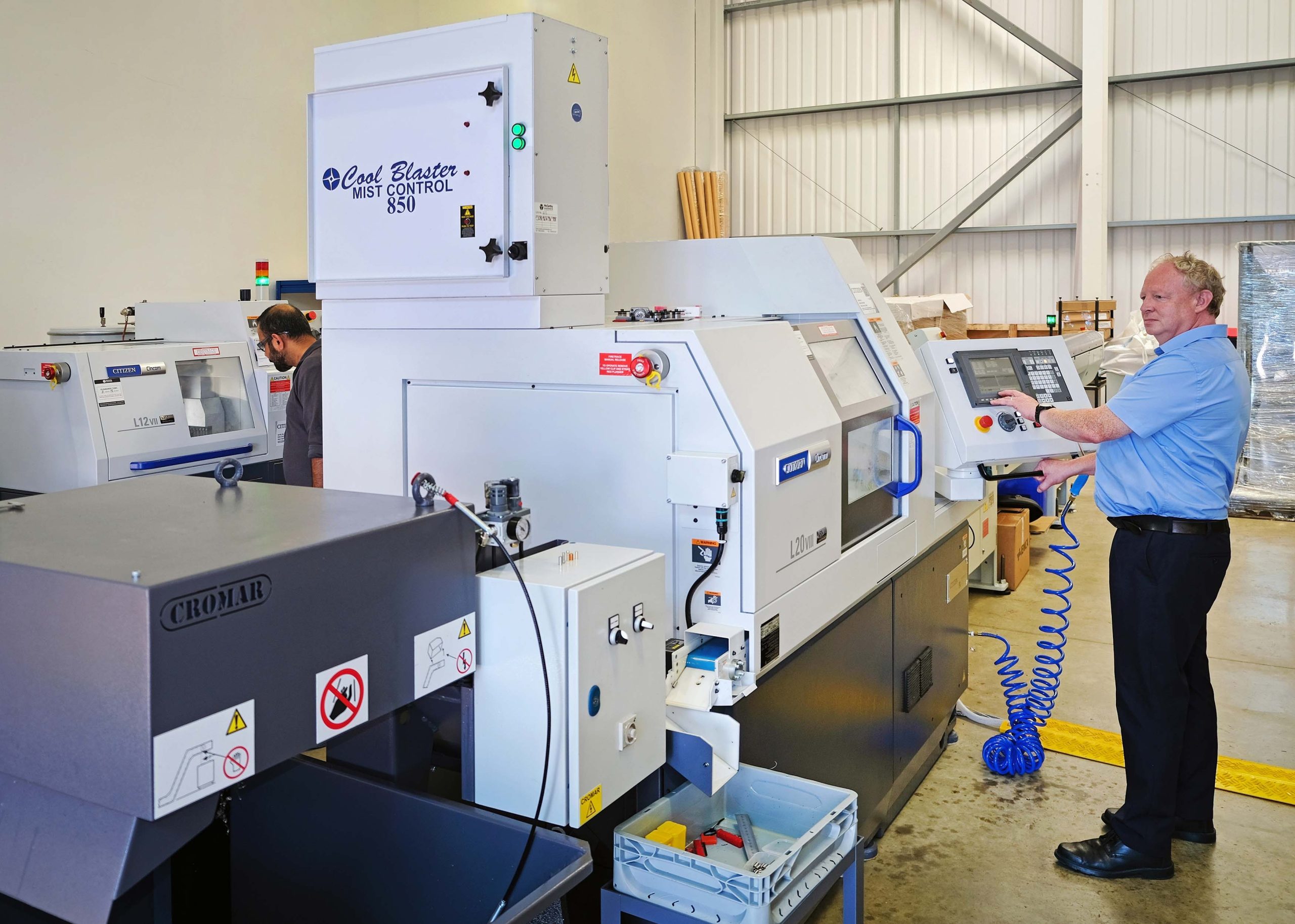
Mr Walker with the Cincom L20-VIII LFV in a temporary facility, shortly before the lathe was relocated into the main factory in Ely after removal of the earlier Citizen lathes.
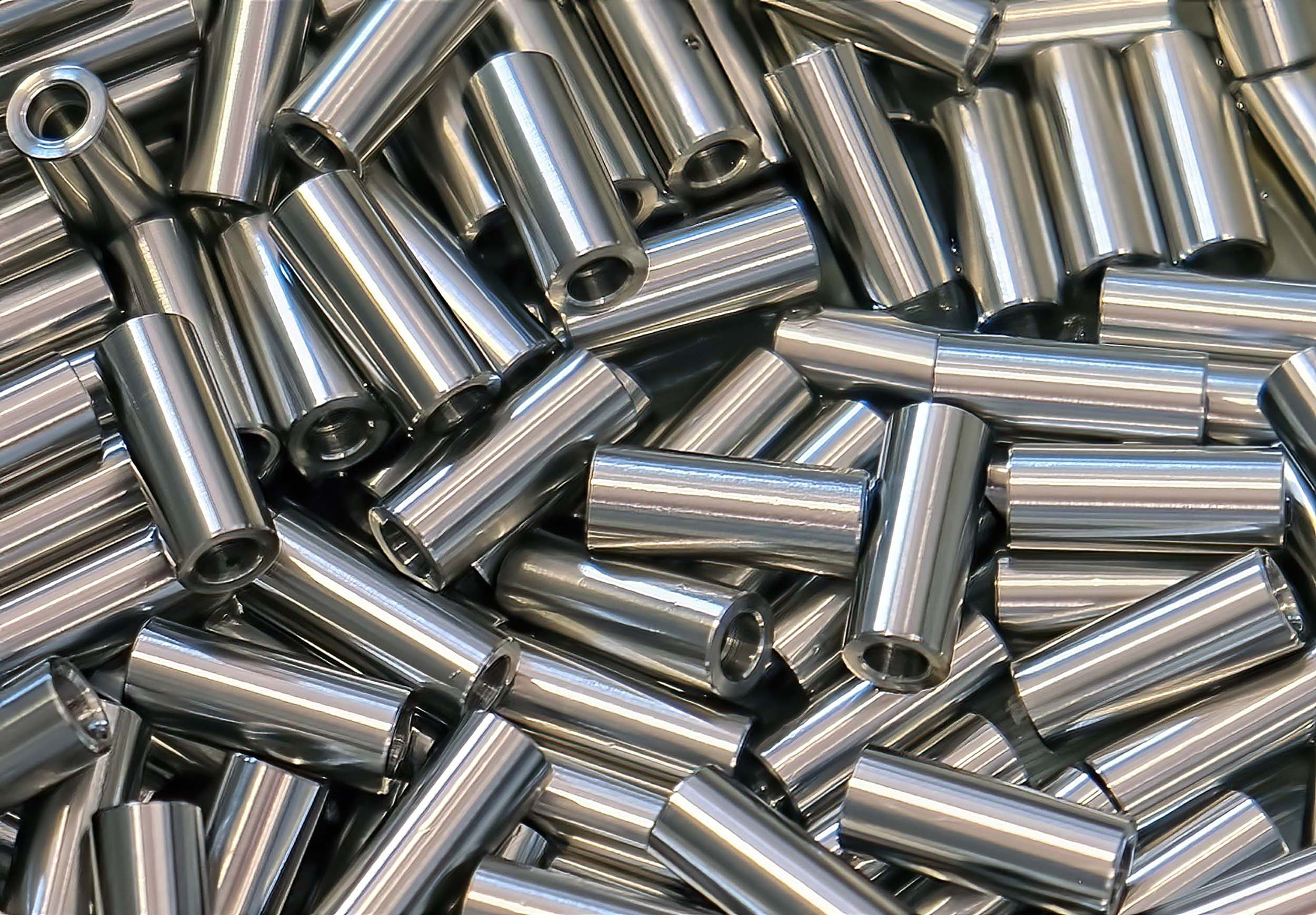
Regarding connector machining, their production from stainless steel, brass, copper or plastic bar between 6 and 16 mm diameter and up to 3.7 metres long has been transferred from the former 1997-built sliding-head lathe to a new Cincom L20-VIIILFV. Thanks to the machine’s greatly enhanced specification, there has been a four-fold reduction in cycle time from typically two minutes down to 30 seconds.
According to Mr Walker, the aesthetic appearance of the machined surface finish is considerably better than before, another indicator of the rigidity of modern Citizen lathes. Additionally, those connector variants requiring cross drilling and flat milling can now be produced in-house, whereas previously they had to be bought in. Drawing tolerances are down to ± 0.05 mm and all parts go for inspection.
Stainless steel connectors after turning on the Cincom L20-VIIILFV. Drawing tolerances are down to ± 0.05 mm and all parts go for inspection.
There are 500 designs of electrode and a similar number for connectors, which underlines the need for machining to be wholly controlled in-house, as well as lamp assembly. Subcontracting out such a variety of parts would be incredibly difficult to control. Component batch size is low for sliding-head lathes, around 1,000-off, to support lamp assembly quantities of 50 at a time across a catalogue of 2,000 varieties. Such small volumes supplied by a subcontractor would be expensive, which is another good reason for bringing all machining in-house at Ely.
Musing on the future of the company, which he owns in partnership with managing director Martin Churchley, Mr Walker concluded, “Our new, highly capable Citizen lathes, despite being fewer in number than previously, produce four times more connectors during our 6.00 am to 6.00 pm day shift, as well as all of our electrodes, many of which we were previously having to buy in.
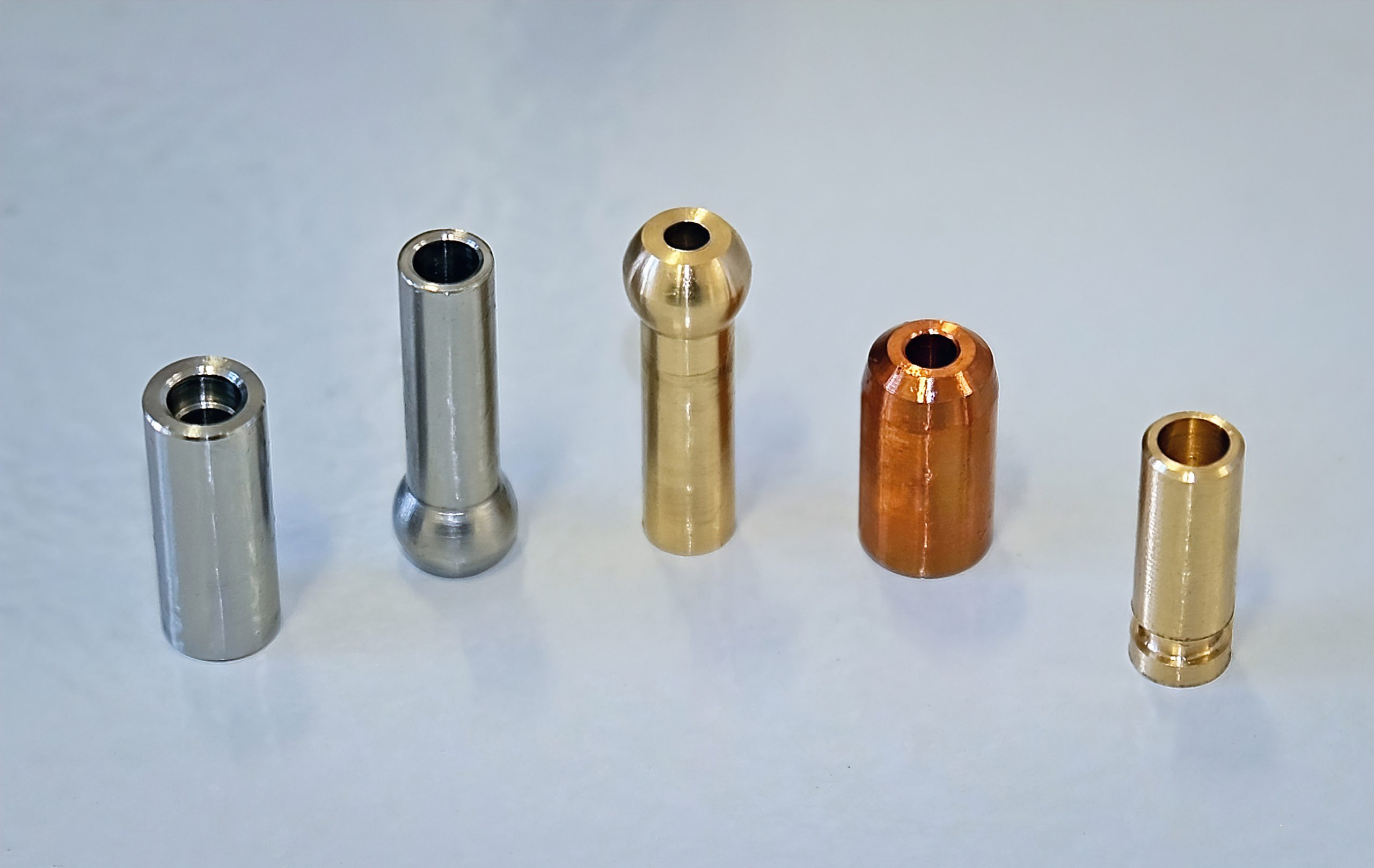
Connectors are also machined from brass and copper, as well as plastic.
“The bar-fed turning centres have the capability to run 24 hours a day, overnight without supervision, which would have been impractical with the old machines. It has the potential to double production output and underpin our 100 percent in-house manufacturing capability for years to come.
“The support provided by Citizen over the years has been extremely helpful, even though we were operating second-hand machines, so we had no hesitation in returning to them when we were in a position to buy new lathes.
“They were supplied as turnkey installations complete with programs and tooling, based on the successful demonstrations at Citizen’s technical centre, so production started immediately after they were delivered and our staff had been trained.”
In September 2024, a third-generation Cincom A20-VIILFV sliding-head turning and milling centre of 20 mm bar capacity was added to the small parts turning section at bicycle aftermarket components manufacturer, Hope Technology, Barnoldswick. Then in May this year, a 12 mm bar capacity Cincom L12-VIILFV arrived on the shop floor. Supplied by Citizen Machinery UK, they were respectively the eighth and ninth sliding-head lathes to be purchased from the Japanese machine builder’s UK subsidiary, or the previous sales and service agent NC Engineering, since 2004. In addition, from 2013 until now, seven Citizen Miyano fixed-head lathes have been supplied.
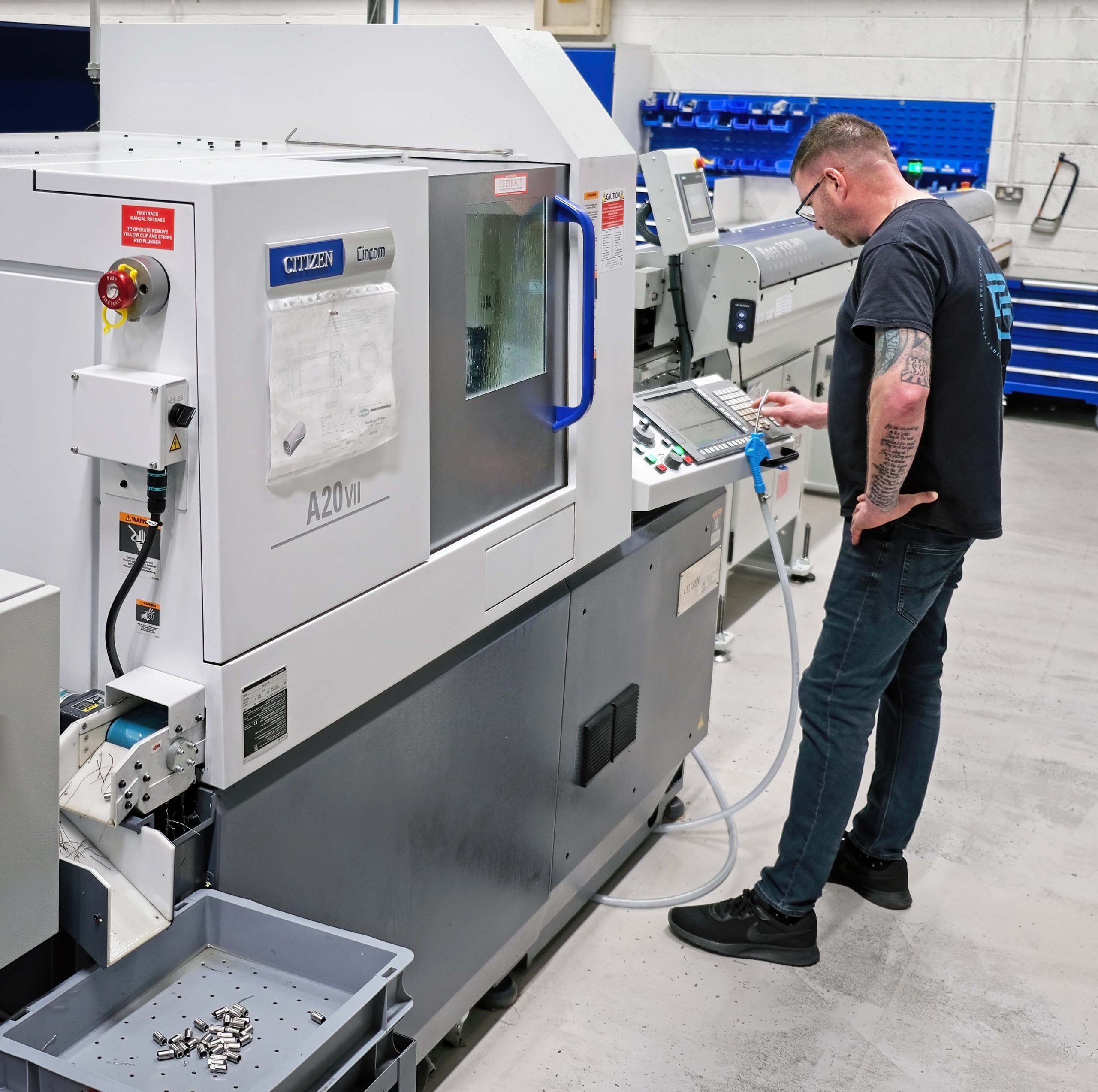
Andy Savage operating the latest Citizen Cincom A20-VIILFV, delivered to Hope Technology in September 2024. All Citizen lathes in Barnoldswick are fitted with a Fanuc control system.
Hope Technology employs around 150 people and exports half of its rapidly expanding portfolio of products to more than 40 countries. The highly successful British business, which was founded in 1989 by ex-Rolls-Royce aero engineers Ian Weatherill, who is now CEO, and the late Simon Sharp was based on a quest to make mountain biking safer by developing and producing a disc brake as an alternative to less effective cantilever brakes.
The company produces 100 percent of its products in-house from top quality materials, mainly aluminium bar, billet, sheet and forgings, plus stainless steel, brass and carbon fibre. It not only machines everything in Barnoldswick to control precision and quality, but also heat treats, anodises, polishes and assembles on-site.
The third person to join the company, also in 1989 from the same aero engine manufacturer, was the current works and production manager Lindley Pate. His long-term employment puts him in an ideal position to comment on the purchase and use of the more than 70 CNC machine tools currently in use in the factory.
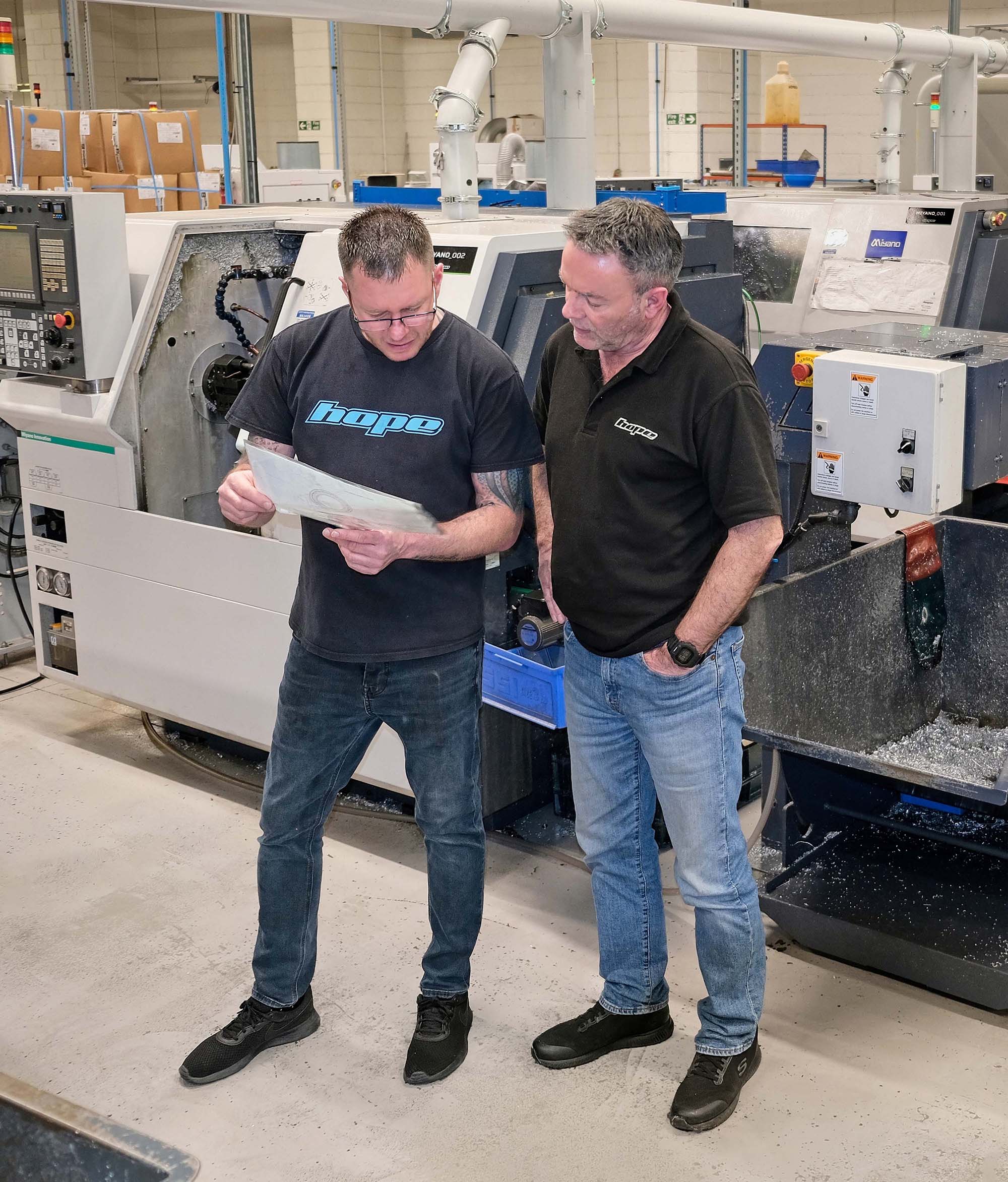
Lindley Pate (right) with Andy Savage, the supervisor in charge of the small parts turning section in Barnoldswick, in front of Citizen Miyano fixed-head lathes.
He explained, “We are constantly buying machines to cope with the sheer volume of orders and the latest Cincom is no exception. When we opened our first factory in Nelson, we opted for another make of sliding-head lathe, three of which are still in occasional use.
“However, the mainstay of the Swiss turning section are the six 20 mm bar capacity models we have sourced from Citizen, plus a 16 mm and a 32 mm model and now the 12 mm sliding-head lathe. It was the speed of the machines and their ability to match our larger volume production needs that prompted the swap to this supplier.”
It is a similar story with the lathes in the larger bar-fed fixed-head turning section, which are up to 65 mm capacity. Between 2013 and 2020, seven Citizen Miyano turn-mill centres were installed, six of 42 mm capacity and one 51 mm lathe. Production of many parts within the capacity of these machines has been transferred to them from larger lathes to allow quicker cycles on the more suitably sized production centres. One example is a bicycle rear cassette lockring made from 7075 aluminium, which is now produced in a significantly shorter cycle time on a Miyano.
Mr Pate added, “As with all of the production plant we buy, it is the level of service from the supplier, in this case Citizen, as well as the productivity of the machines that are paramount and lead to our repeated purchase of Cincom and Miyano lathes.”
An ability to maintain production output reliably around the clock is crucial for all plant in Barnoldswick in order to maintain global delivery schedules. Consequently, it has been decided to retrofit swarf conveyors to the two newest Cincom A20s to prevent aluminium swarf building up in their machining areas, allowing long periods of lights-out running.
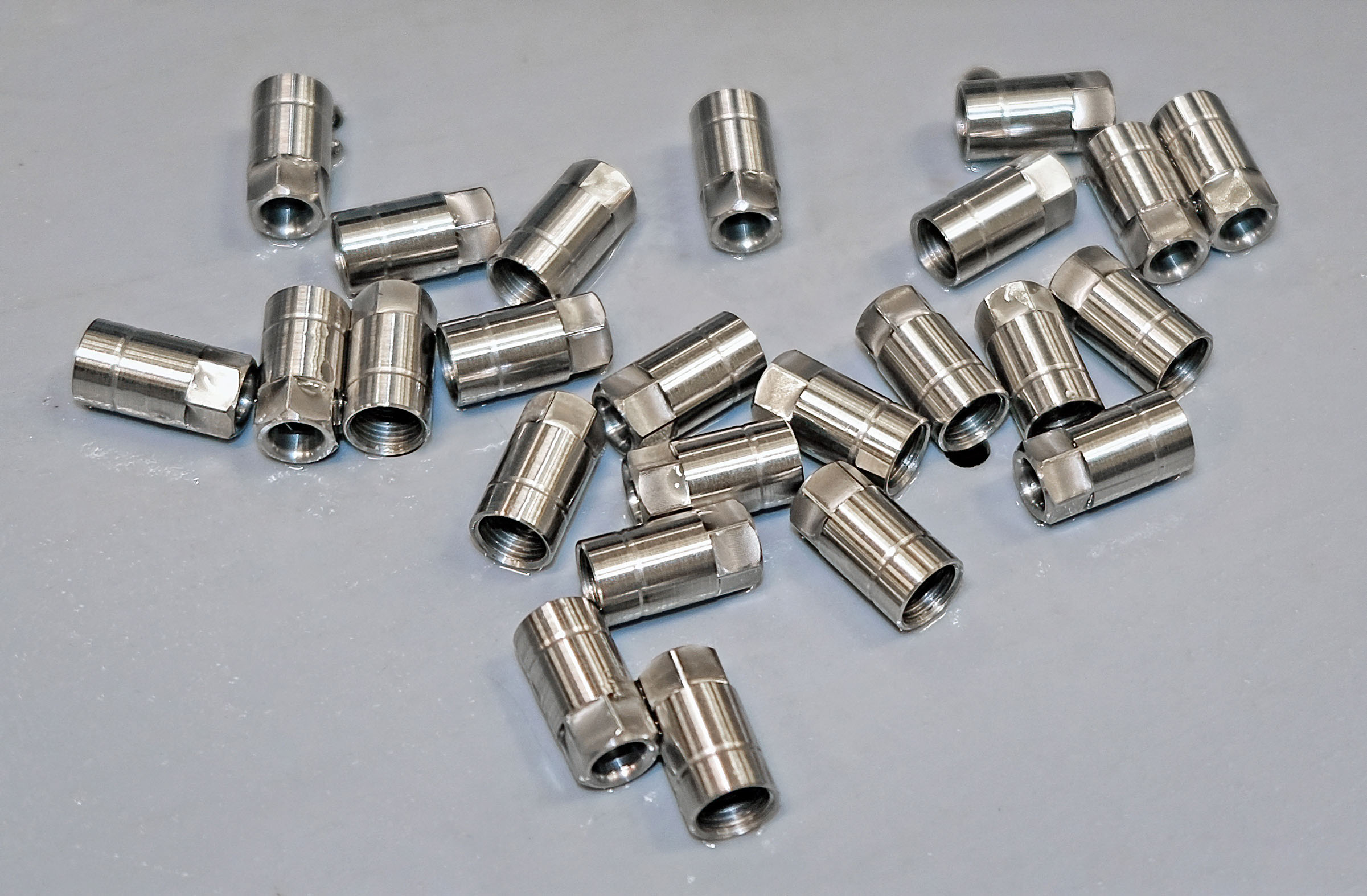
Hose shrouds produced on the Cincom A20-VIILFV. There is no enterprise resource planning at the Hope Technology factory; parts and assemblies are manufactured for stock based on historical sales figures and average weekly or monthly call-off.
Citizen’s programmable LFV (low frequency vibration) chip breaking functionality in the control fitted to the latest three A20s helps in this regard. It ensures that swarf is broken into short chips that are easy to remove, rather than becoming ribbons that wrap around the component and tool. This scenario is avoided by switching in LFV during problematic sections of a cutting cycle. It means that the lathe does not have to be stopped for manual removal of tangled swarf, which would lead to lost production and possible damage to the part being machined and/or the cutter.
Modern Cincom lathes have the additional advantage of the option of removing the guide bush if it is expedient to do so. While until now this has rarely been done in Barnoldswick, the supervisor in charge of the small parts turning section, Andy Savage, is intending to take advantage of the capability. It will save material cost when machining parts shorter than typically two and a half times their diameter, a geometry that does not deflect appreciably in the radial direction when the tool engages the bar with the guide bush absent. The benefit is two-fold. First, it allows extruded bar to be used, as on the fixed-head lathes, rather than more expensive drawn bar. Second, each bar remnant is two to three times shorter, saving a considerable amount of material.
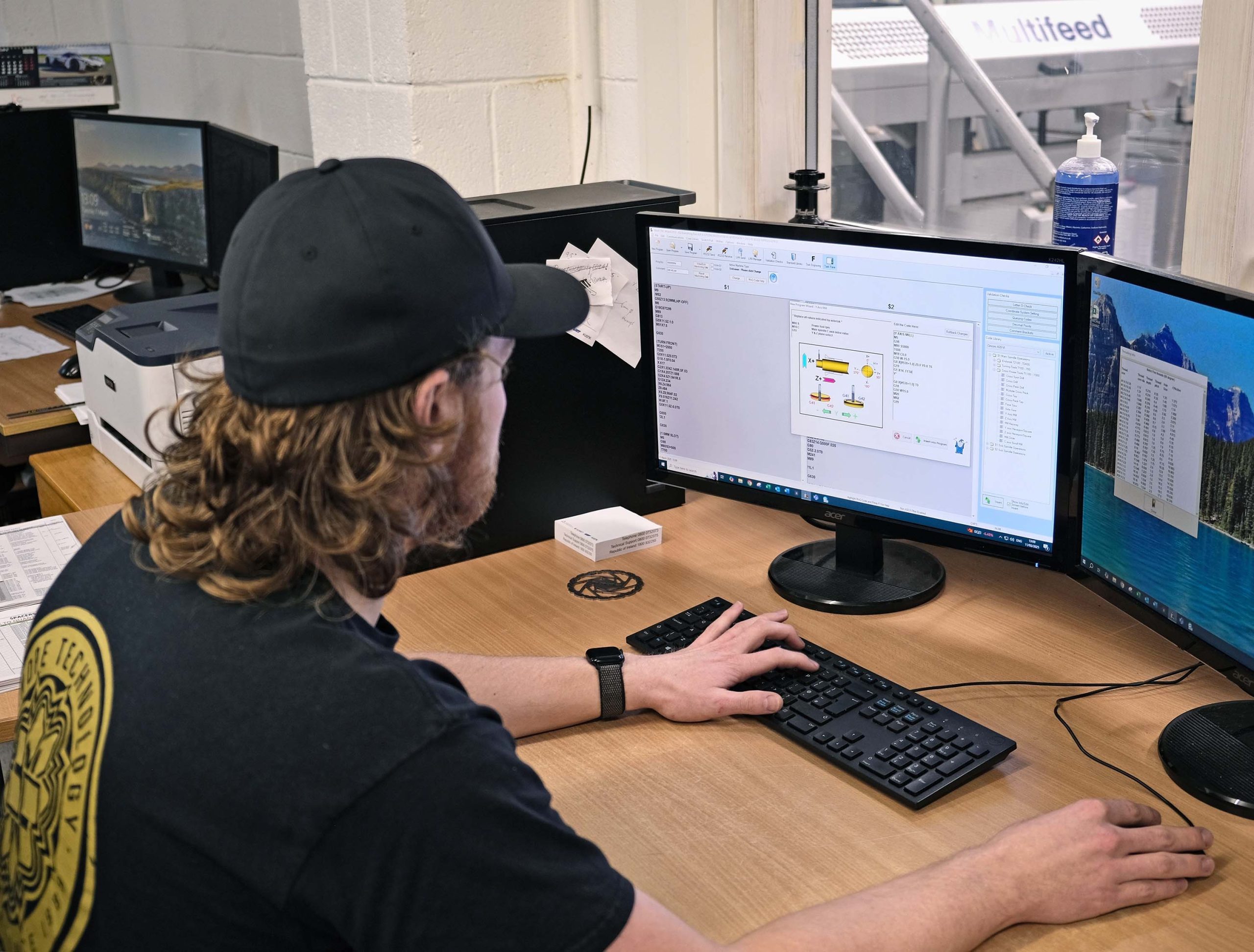
Continual use is made by Hope Technology of Citizen Machinery’s Alkart Wizard software to speed writing part programs and reduce the potential for errors.
Continual use is made by Hope Technology staff of Citizen Machinery’s Alkart Wizard software, which speeds CNC program preparation for both the Miyano and Cincom lathe models. It provides a user interface that simplifies complex tasks by breaking them down into a series of easy-to-follow steps. To assist in program development and reduce the potential for errors, Alkart Wizard incorporates a library of pre-defined machining processes and graphical diagrams. The software also allows users to save and reuse portions of CNC programs that have been created, helping to save time and increase efficiency.
Mr Pate concluded, “Tolerances held on our products are normally fairly open, but +0.01 mm has to be achieved on bearing diameters, a level of accuracy that is no problem for Citizen lathes. Our continued purchase of them over a period of more than two decades is primarily down to their reliability, however, ensuring we can get product out of the door quickly to our markets around the world.”
TURNED PARTS SUBCONTRACTOR CONTINUES EXPANSION
The installation in April 2025 at Dawson Precision Components of a Citizen Cincom L20-XLFV sliding-head lathe brings the subcontractor’s tally of CNC turn-mill centres to 21, most of which are bar fed and have driven tooling. The high-precision turned parts specialist, which is required by some customers to hold tolerances down to single-figure microns, also operates three vertical machining centres mainly for second-operation work on larger turned components.
The additional Cincom lathe brings the proportion of sliding-head lathes as distinct from fixed-head models in the Oldham factory to nearly three-fifths, or more if one takes into account a Citizen Miyano BNA-42GTY. It is a hybrid fixed/sliding-head lathe capable of operating like a slider in guide bush-less mode, with the headstock able to move in and out of the working area.
The subcontractor has been growing organically since the 1970s and has expanded its factory four times, most recently in 2024 when the shop floor was increased by nearly 50% at a cost of £1.2 million. In the early days, the company fulfilled contracts mainly using single-spindle cam autos, but these had disappeared by the mid-1990s to make room for CNC fixed-head lathes.
It was not until the year 2000 that the first three CNC Cincom sliding-head lathes were installed, all 20 mm capacity L20-VII models that initially were devoted to producing large volumes of body jewellery from titanium bar. As is nearly always the case, once such capacity is available the work builds up and sliding-head contracts now account for a majority of throughput.
Several 12 mm capacity Cincoms have also been purchased, the latest being a pair of L12-VIIs which arrived in 2014. There are also 38 mm capacity models on the shop floor, the most recent an M32-VIII installed in early 2023 having an expansion kit allowing it to produce parts from bar up to 35 mm in diameter.
The newer sliding-head turn-mill centres benefit from the ability to remove the guide bush in about half an hour, allowing better accuracy to be achieved when turning components, particularly with regard to concentricity. The approach is ideal for producing components that are shorter than nominally two and a half times their diameter and has the added benefit of considerably reducing the bar remnant length.
This not only saves cost, but also allows more components to be produced from a single bar, so the guide bush is removed for as much as 10% of production on the seven Cincoms in Oldham having the facility. A further advantage of guide bush-less operation is that the use of rolled bar whose diameter varies by up to 0.2 mm can be tolerated, whereas sliding-head operation normally requires the use of ground bar accurate to within 30 or 40 microns.
To get around this problem and enable less expensive bar of lower quality to be used for traditional sliding-head turning, a JBS compensating guide bush has been fitted to the latest L20-VIIILFV and Dawson Precision Components has retrofitted another one to a similar machine installed in 2022. The bush continuously compensates for variations in the diameter of the bar as it advances into the machining area, leading to high machining accuracy, repeatability and process reliability. Another advantage of the JBS system is its ability to dissipate heat generated when machining tough alloys, reducing even further the possibility of material seizing within the guide bush.
A vast array of materials is machined by Dawson Precision Components for customers in the medical, life sciences, space, defence, communications, rail, motorsport, leisure and other sectors. They include plastics like PTFE, PEEK, acetal and nylon, which collectively account for up to 15 percent of production output. The ability of Citizen’s LFV operating system software to break what would normally be stringy swarf into short, manageable chips is a key reason for the subcontractor choosing the chipbreaking option on its three latest Cincoms, as well as the Miyano.
It is similarly effective when turning copper and numerous types of aluminium, while stainless steels, titanium and brass are also regularly processed in Oldham. General tolerance stipulated on drawings is ± 0.1 mm, but some medical parts need to be machined to 5 microns total. Usual batch size varies from 5 to 200, but exceptionally can be up to 20,000. Production is over a flexible shift pattern, including long periods of autonomous running. Lights-out operation is avoided due to the often tight tolerances that need to be achieved.
Mr Dawson said, “There is no doubt Citizen lathes last a long time – we have one on the shop floor that is still producing components and holding tolerance after 25 years. Our policy, though, is to replace them regularly to take advantage of the higher productivity that modern, faster machines allow, as it makes it easier to compete for new work.
“With the high cost of electricity these days, reduction in power consumption is becoming ever more important. Thankfully, contemporary Citizen lathes with their advanced ecological features are more economical to run than earlier models. We have just had solar panels fitted to our factory, which provide about one-third of our electricity consumption. These measures are helping us reduce costs and will make us even more competitive going forward.”
NEW ECO-FRIENDLY SLIDING-HEAD LATHES
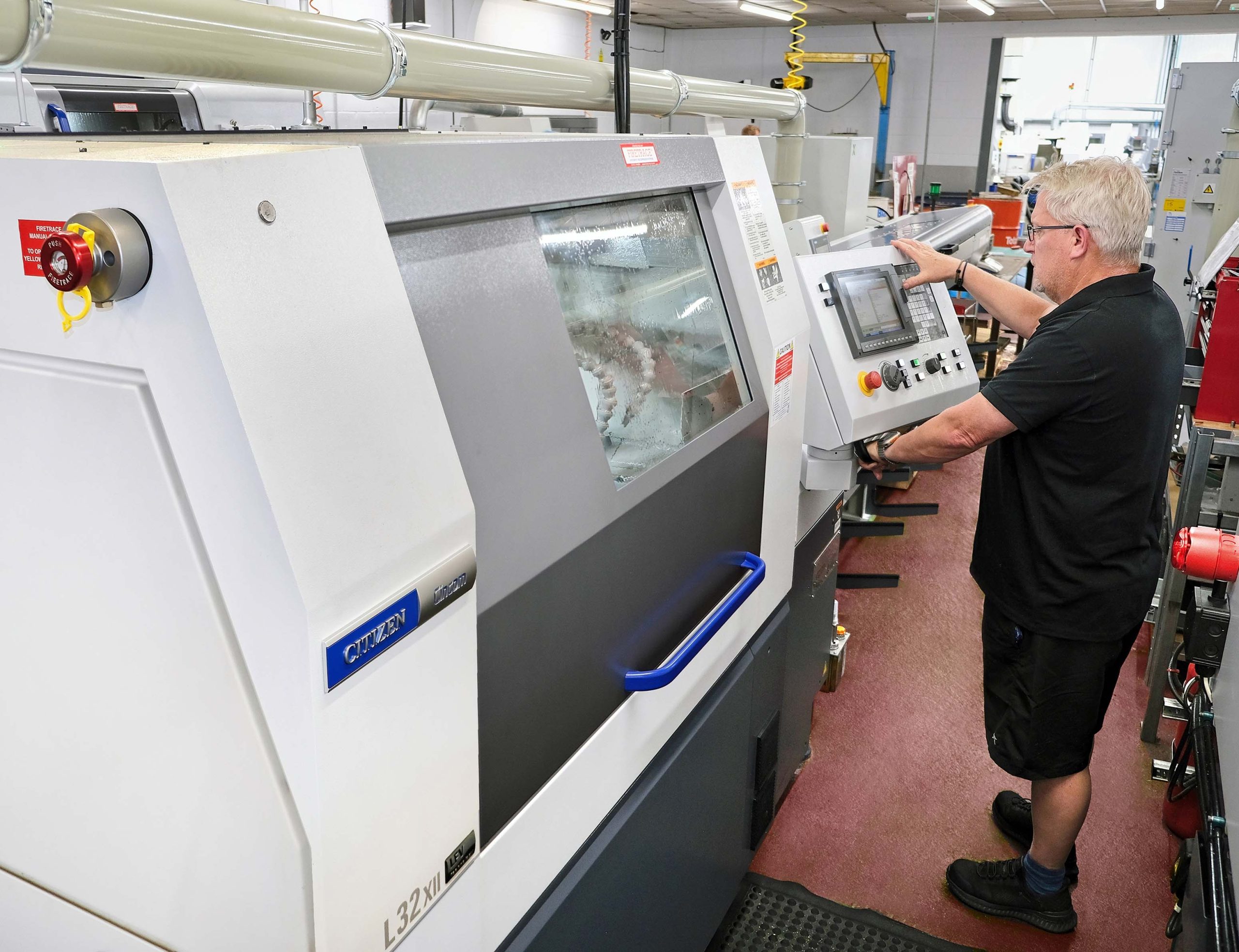
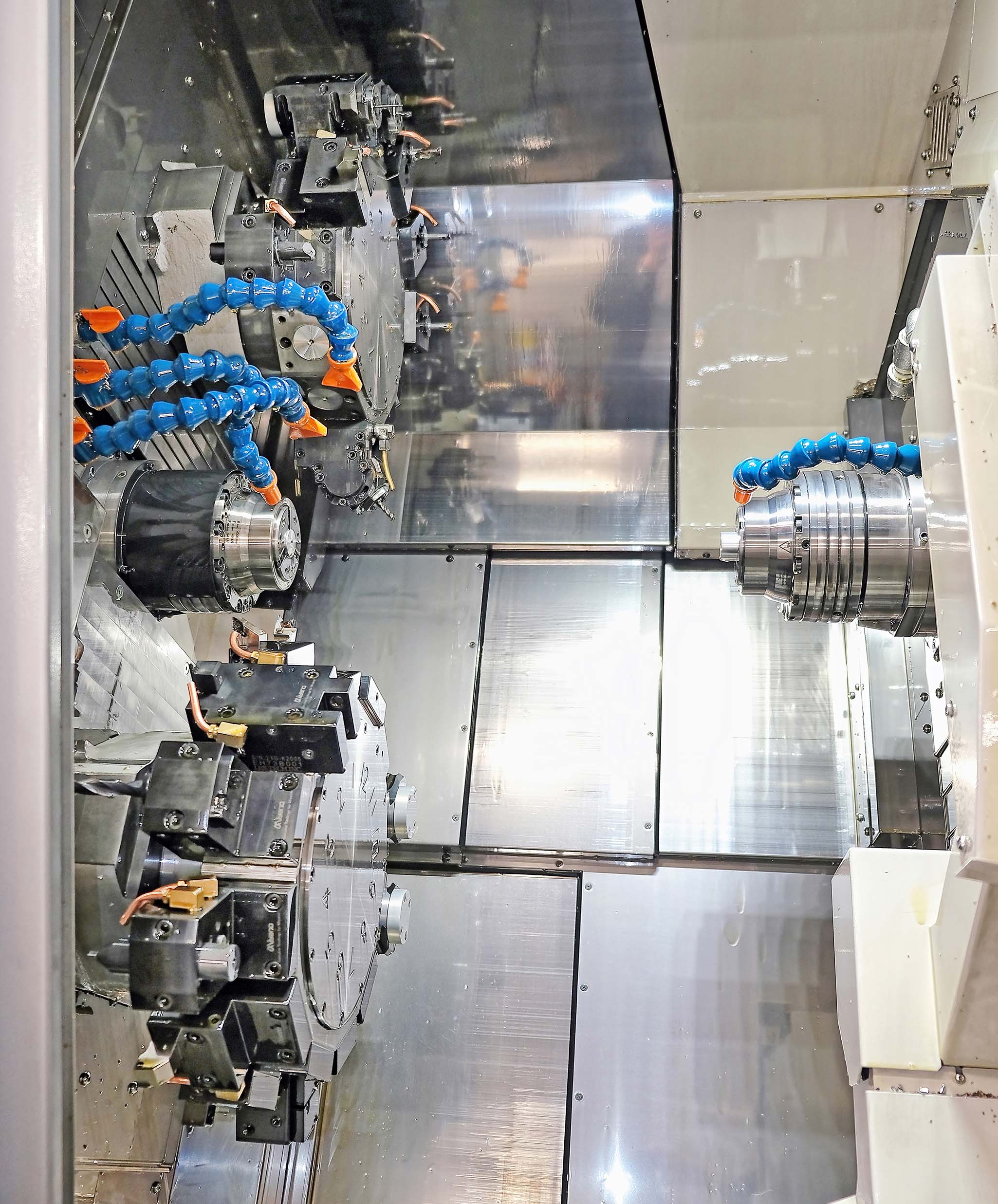
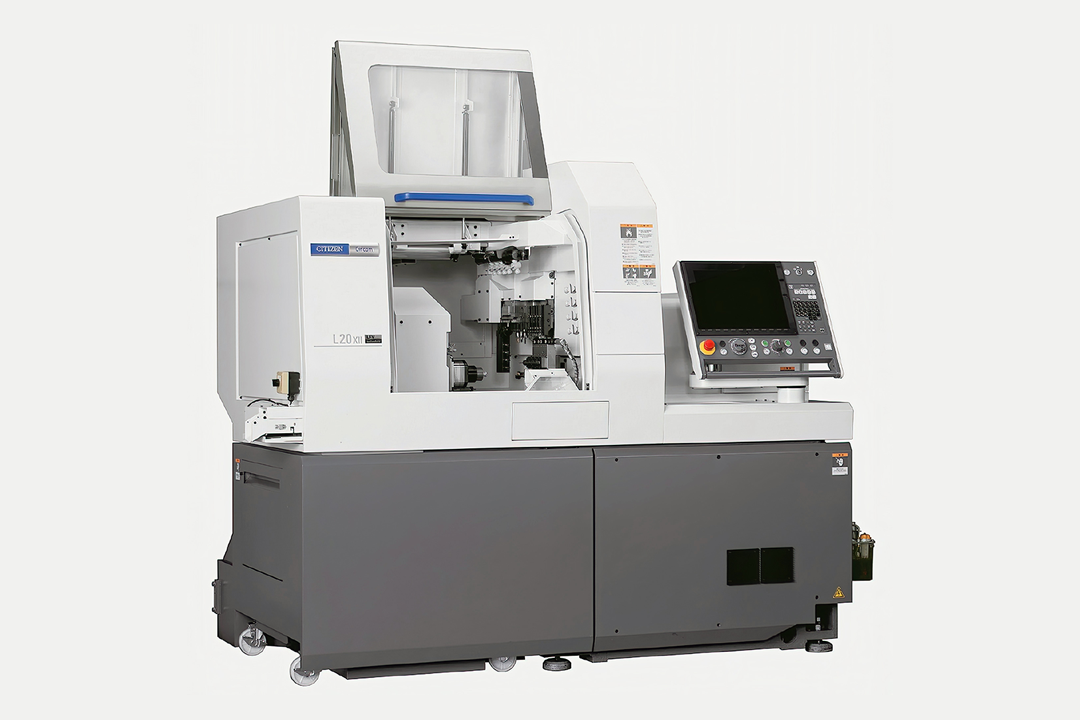
For machining parts from bar up to 20 mm in diameter (optionally 25 mm), a third generation of the Cincom L20-LFV series of sliding-head lathes with a considerably uprated specification has been launched by Citizen Machinery UK. Now offered in four variants, VIII, X, XII and XIIB5, it is a best-selling model with platen tooling as well as front and rear tool posts, all stations having driven and static positions on the top three models, which also have additional Y-axis movement of the sub spindle.
Simultaneous 5-axis control for performing complex machining cycles is supported on the XIIB5, with the ATC and XII variants supporting a 4+1 axis. The VIII, X, XII and XIIB5 gang cross live tools can machine up to 9,000 rpm and the ATC up to 12,000 rpm so even small diameter end mills are capable of productive metal removal rates. The additional programmable B-axis motion raises the total number of CNC axes to seven.
The Japanese manufacturer was the first to offer B-axis ATC on a sliding-head lathe to extend the machine’s versatility when executing angled cross working or end facing operations. The magazine accommodates 12 tools, while a 13th is fixed in the upper position on the live tool unit. While cutters are normally rotating for performing drilling, slitting, hobbing or multi-axis milling, either axially, radially or at a compound angle, magazine positions may be occupied by turning tools if expedient.
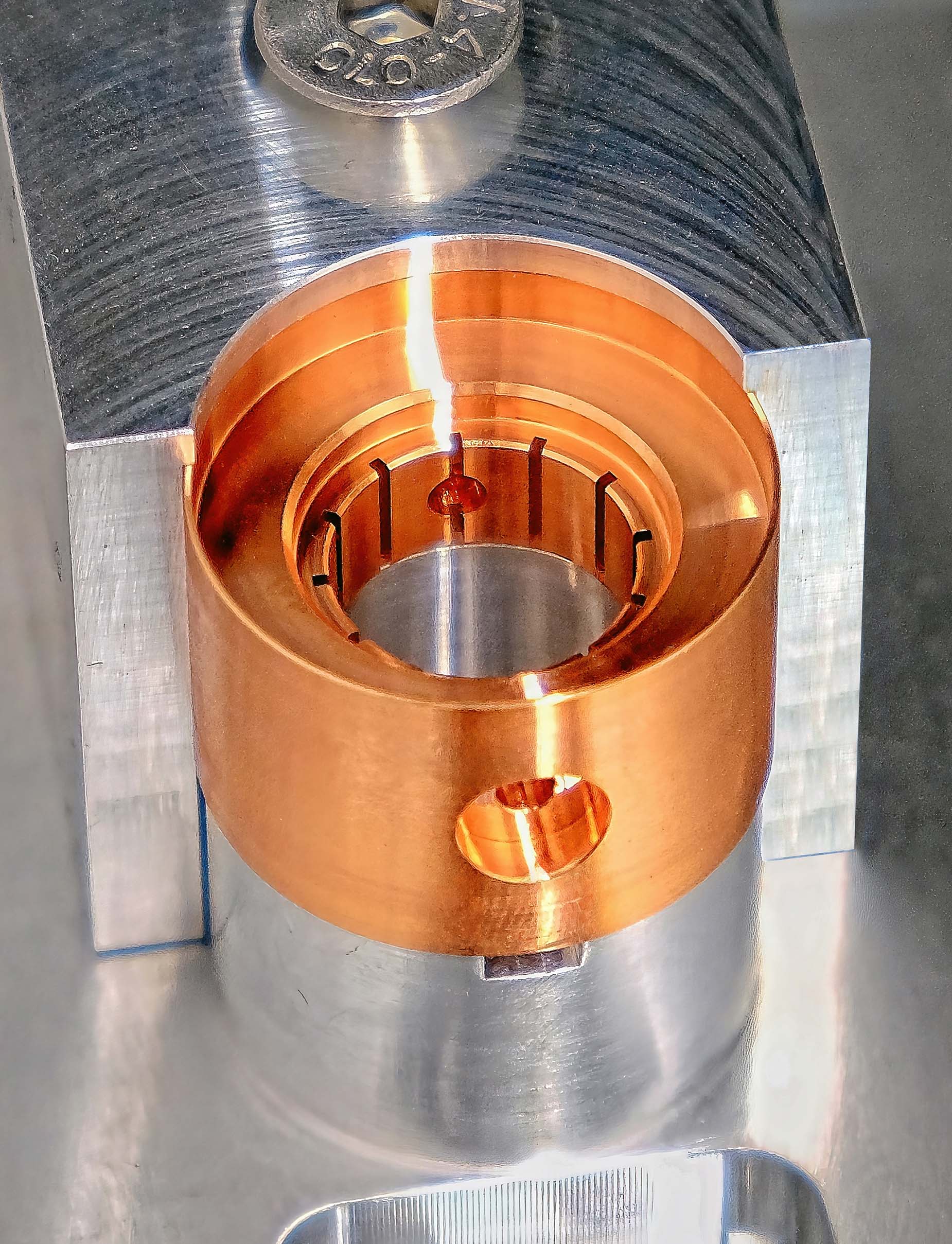
Another feature contributing to the lathe’s versatility is the ability to switch over quickly between Swiss-type operation and non-guide bush turning for more economical production of shorter components. This mode results in less bar wastage due to the shorter remnants and is well suited to coping with tight drawing tolerances and close bore-to-OD geometry. Removal of the guide bush also means that the diameter of the stock material does not have to be tightly controlled.
All lathe versions are supplied with the manufacturer’s programmable LFV function embedded in the operating system of the Windows-based Mitsubishi control, which is equipped with a 15-inch touch screen for easy visibility and intuitive operation. The three LFV modes of operation work at either spindle by oscillating the X and Z servo axes in synchrony with spindle rotation, breaking stringy swarf into short, manageable chips. It is especially effective when producing parts from malleable materials. The results are higher productivity by avoiding machine stoppages to clear away swarf manually, prevention of damage to the workpiece and/or tool, less tool wear and a better finish on the machined surface. LFV can also be used on the main and sub spindle across all models in the L320 range.
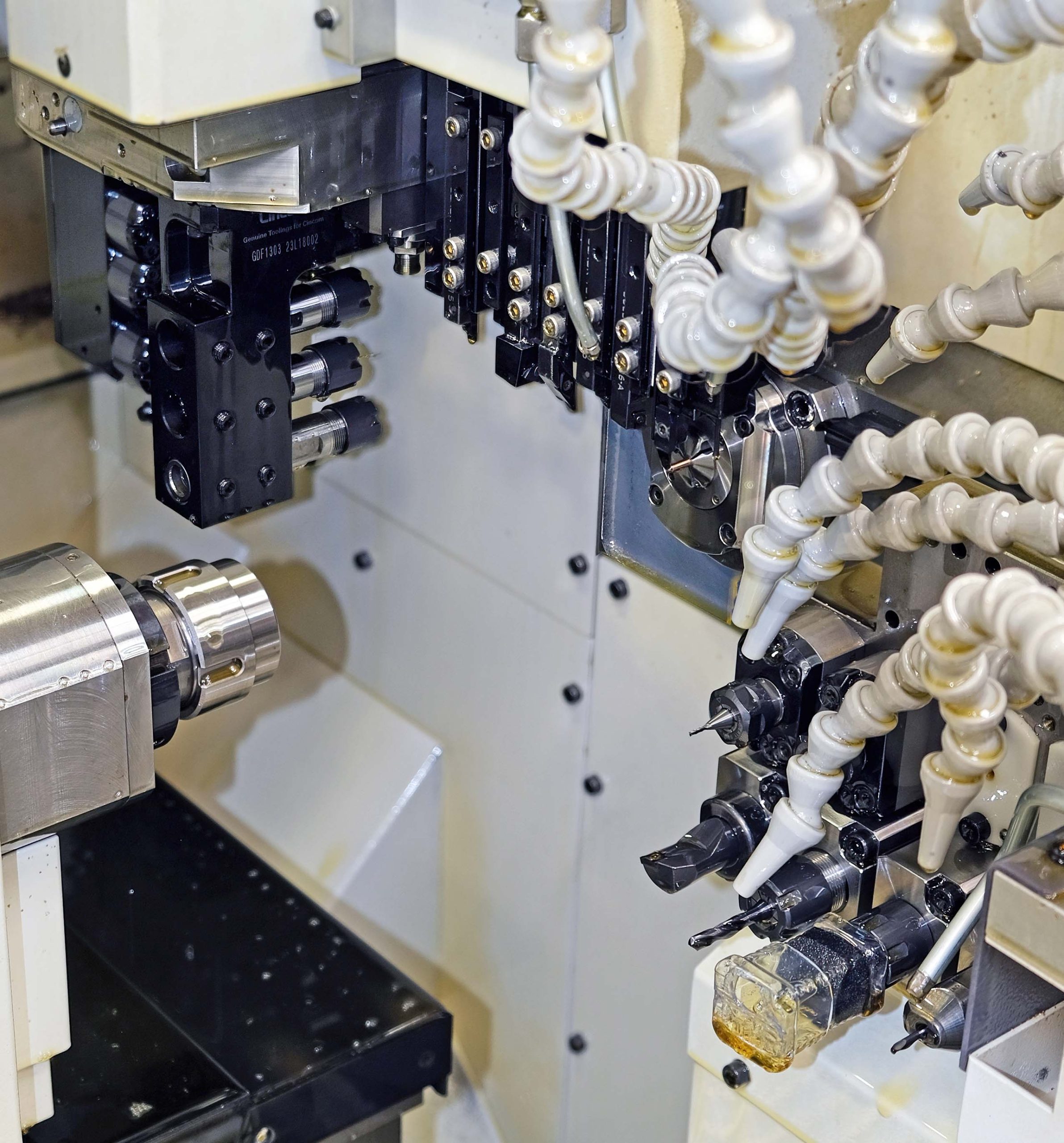
The number of turning tools that can be mounted on the gang tool post has been increased from five to six, so up to 45 tools may now be held in the machining area for enhanced machining capability. Citizen Machinery’s quick-change CIToolingSystem speeds tool exchange and improves repeatability of postioning to ±2 microns radially and longitudinally.
Access to the machining area has been improved, as the front door may now be fully opened and an extra door has been provided at the rear. Internally, units have been made as compact as possible and the coolant nozzles have been rearranged to improve efficiency during setup. Another improvement has been to upgrade the capability of the sub spindle, which is now rated at 3.7 kW / 10,000 rpm. Numerous robotic loading and unloading systems for automated storage and handling of raw material and finished workpieces are available.
Citizen Machinery’s Eco II suite of energy-saving features are incorporated, designed to optimise power consumption, reduce compressed air usage, minimise CO2 emissions and promote environmentally friendly manufacturing practices by allowing operators to monitor and understand energy utilisation patterns.
For example, an idling stop function puts the machine into standby when no programmed operation is in progress. The machine is equipped with intermittent air blow that maintains its effectiveness while reducing compressed air consumption by about 60%. Air purge control shuts off the function after a preset time while the machine is on standby to reduce air consumption further. A touchscreen Eco Monitor continuously displays in graphical form the power drawn and regenerated to ensure the lathe always runs at peak efficiency.
Citizen’s IoT-ready turning centres are compatible with its ‘alkapplysolution’ software, allowing them to be networked via a simple LAN connection. It enables users to take advantage of various software packages for tasks like NC program management and machine operation data monitoring.
Specifically, ‘alkartlive 2’ software enhances production efficiency by visualising machine downtime and automatically aggregating data to reduce manual effort and enable preventive / predictive maintenance planning. The software displays machine status with colour-coded indicators on a timeline, alongside production results and alarm history, providing a clear overview of factory-wide operations.
LONGER PRODUCTION RUNS OF TURNED PARTS DICTATE MOVE TO SLIDING-HEAD TURNING
SFC (Europe) is a market leader for the manufacture, stocking and supply of safety-critical and high-performance studbolts, bolts and nuts in ASTM and ASME grades for onshore, offshore and subsea applications. They are mainly destined for global energy customers, but are also used in the automotive, valve, heat exchanger and pumps sectors. The Wolverhampton company has enjoyed impressive growth, from a turnover of £1 million when it was formed in 2013 to £15 million in 2024.
In the early days, the company served mainly the oil and gas, petrochemical, valve and renewable energy sectors, which involved turning batch quantities of anything from five to 500 parts, with the occasional run of 1,500. Then in 2018, other industries started to show interest in the products and today the original markets account for only around half of the manufacturer’s turnover. Some of the more recent customers ask for similar, small to medium quantities, but frequently they request 50,000-off, forcing SFC (Europe) to change the way it viewed its turning and milling equipment.
Operations director Mark Edmonds said, “In the early days we bought in fasteners for stock and sold them worldwide, but within six months we had gained ISO 9001 and started manufacturing product, either to customer specification or international standards.
“Our machine tool count was boosted in 2016 through the acquisition of another fastener producer. The capacity was sufficient for the quantities we were producing at the time, but a couple of years later the larger quantities being ordered by customers necessitated a rethink.”
Part of the deliberations was shaped by the metals that need to be machined. As well as carbon steel, they include stainless and superalloyed steels, and nickel and titanium alloys. One nickel-copper alloy, Monel K500, is particularly difficult to machine due to its ductility and abrasiveness. Any new turn-milling centre had to be robust enough to process these materials. It also had to be versatile and quick to set up, as urgent short runs were frequently ordered for next-day delivery while long-running jobs were in progress.
Since 2019, Mr Edmonds and his colleagues had been considering sliding-head bar turning owing to its suitability for producing large quantities of components, including unattended overnight. Covid delayed things somewhat but by mid-2022 SFC (Europe) was ready to make its first investment in new turning centres. It was, however, a pair of fixed-head lathes that was bought, as production staff in the Wolverhampton factory was unfamiliar with operating sliding-head equipment and management wanted modern, productive lathes that would come on-stream quickly.
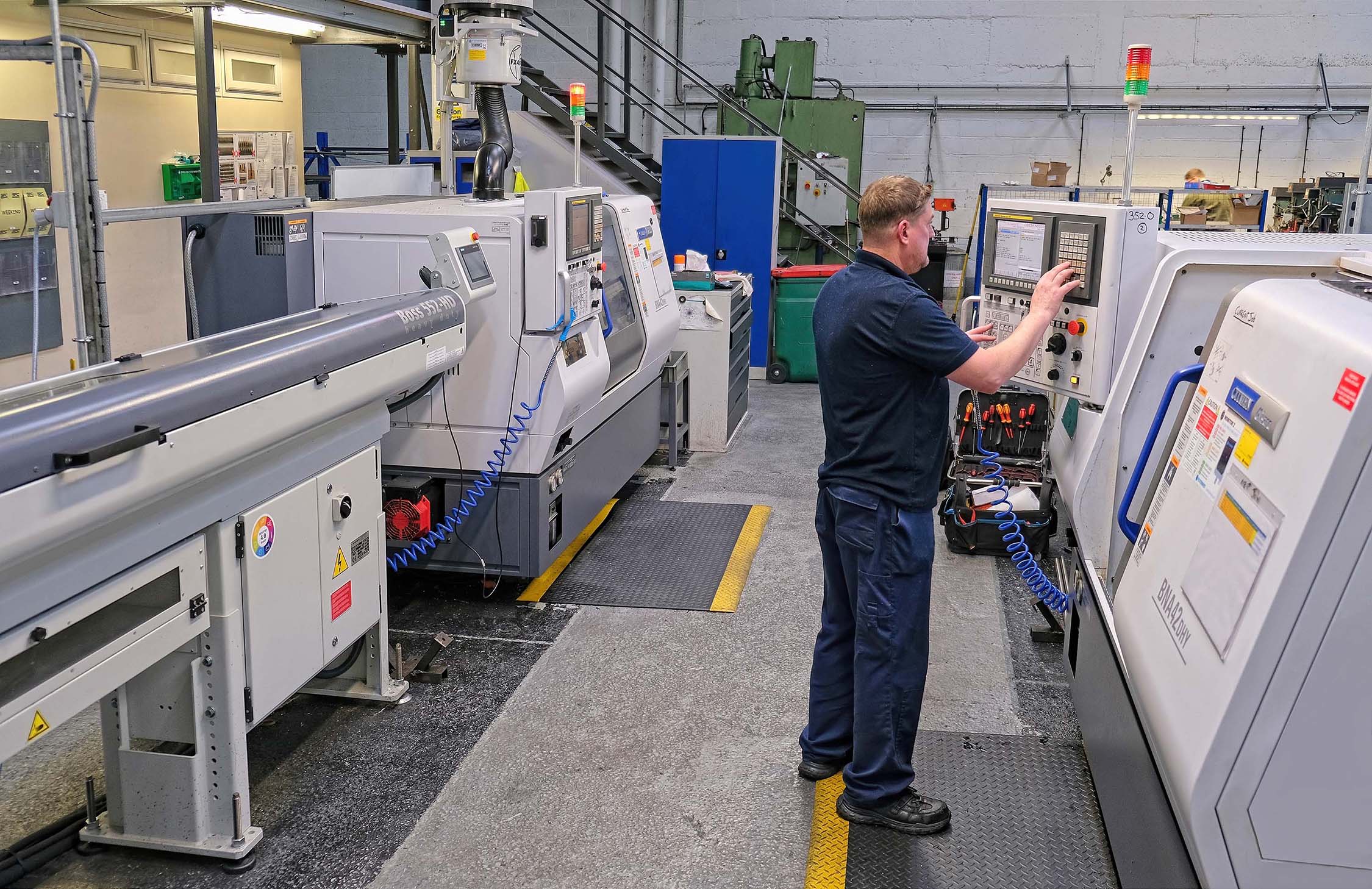
Two identical 7-axis Miyano BNA42DHY twin-spindle, twin-turret, bar-fed lathes were duly installed, the first machines that the manufacturer had sourced from Citizen Machinery UK. The supplier was chosen after subcontractors within the fastener industry had been consulted, as well as Google of course, plus Citizen at one of its open houses. Demonstrations at the Brierley Hill technical centre, where faster than expected, one-hit cycles were shown to successfully replace three or four separate operations, clinched the deal.
A couple of years later, SFC (Europe) was ready to revert to the idea of introducing sliding-head, bar-fed lathes. The Miyanos had performed so reliably in terms of uptime and accuracy that Mr Edmonds looked no further than Citizen for the supply of two Cincom L32-VIIILFV turn-mill centres. Delivered and commissioned in April 2024, they mainly fulfil orders for higher volumes of parts. As traceability is often important, the ability to engrave them in-cycle on the fast, nimble machines saves a separate operation and contributes to maximising production output.
The nominally 32 mm bar capacity lathes are able to machine components from up to 38 mm bar with the guide bush removed, which has the added advantage of saving material due to shorter remnant lengths. Accordingly, one L32 is permanently set up without the guide bush for producing parts up to about 2.5 times diameter, while the other has the guide bush in place for turning longer components.
Mr Edmonds concluded, “Everyone from our founder and chairman Allan Stennett to the machine tool operators on the shop floor are committed to acquiring and using the best production equipment possible. Continued purchase of machines like the Miyano and Cincom lathes will undoubtedly underpin our continued growth for years to come.”
ECO-FRIENDLY SLIDING-HEAD LATHE TO BE LAUNCHED AT CITIZEN MACHINERY OPEN HOUSE
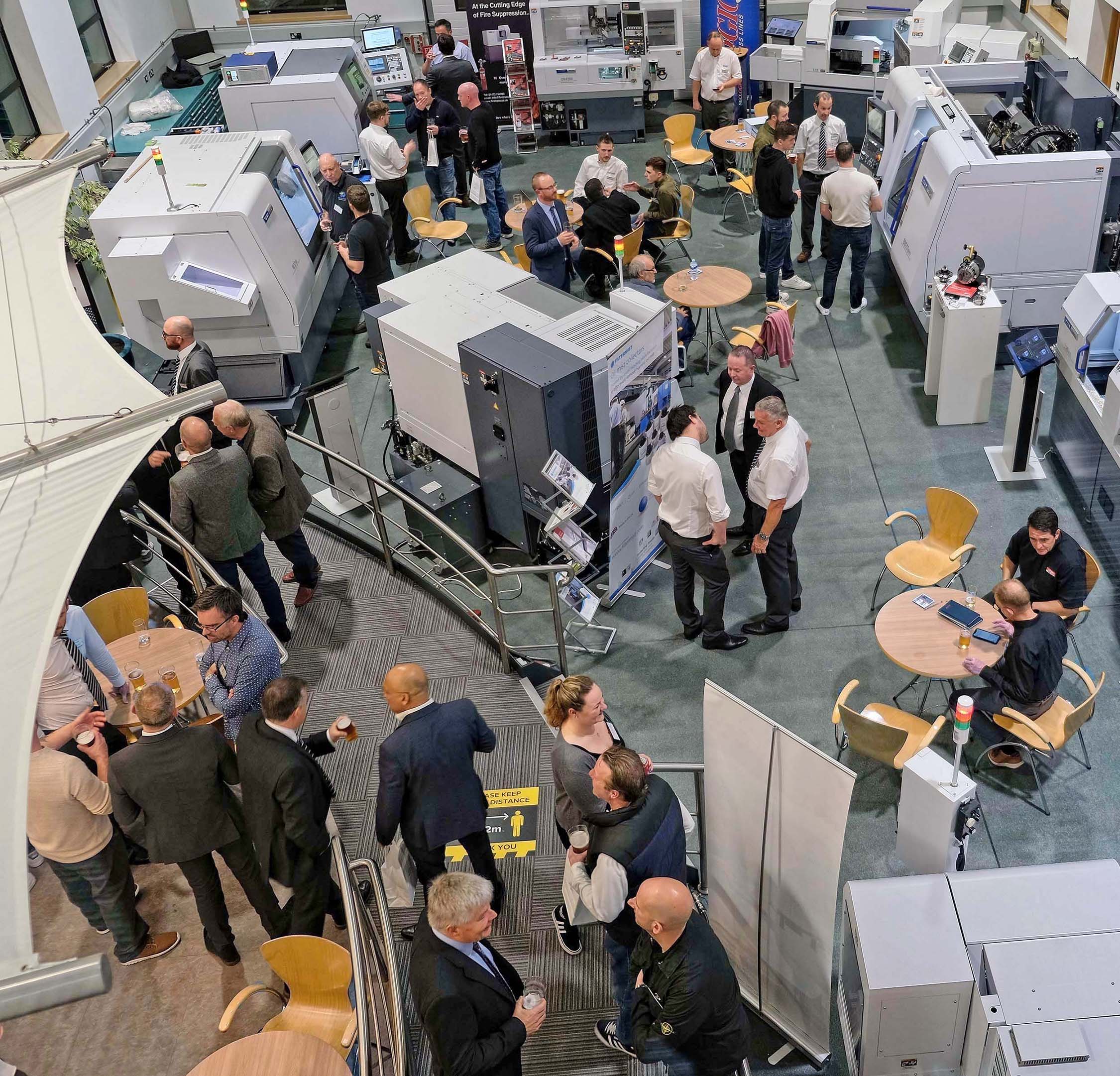
On 8th and 9th April 2025, Citizen Machinery UK will hold an open house at its Bushey, Hertfordshire headquarters, showroom and solutions centre. It is where the UK and Ireland supplier of the Japanese parent company’s sliding-head (Cincom) and fixed-head (Miyano) bar-fed turn-mill centres configures and proves out complex automated machining cells. They often incorporate additional functions like in-cycle laser cutting, peripherals, automation and special software.
The occasion will mark the UK launch of a new range of sliding-head lathes, the third generation of the Cincom L20, a best-selling model with platen-type tooling and front and rear tool posts. It is offered in five variants, including a top model with or without B-axis automatic tool change, both of which support simultaneous 5-axis control for performing complex machining cycles. The turning centre’s specification has been considerably uprated for improved performance and operability. The lathe retains the manufacturer’s unique LFV function that has revolutionised chip-breaking in recent years, especially when machining malleable materials.
New at the event will be Alkart Wizard 2025, Citizen Machinery’s CNC lathe programming software, which includes for the first time a CAD/CAM Toolpath Import function in addition to its user-friendly interface, step-by-step guidance, and built-in library of machining processes, code examples and reference materials. An automated Miyano BNA-42SY5, which is now available with LFV chip-breaking, will be demonstrated to illustrate unattended machining possibilities.
Visitors will learn more of Citizen Machinery’s Eco II suite of energy-saving features, designed to optimise power consumption, reduce compressed air usage, minimise CO2 emissions, and promote environmentally friendly manufacturing practices by allowing operators to monitor and understand energy utilisation patterns. A touchscreen Eco Monitor continuously displays in graphical form the power drawn and regenerated to ensure the lathe always runs at peak efficiency.
CHIP-BREAKING ON LATHES IS HIGHLY FUNCTIONAL
Josh Watkins, director of Welsh subcontractor Harlech Engineering, has recently bought two lathes from Citizen Machinery, a Miyano fixed-head model installed in mid-2023 and a sliding-head Cincom one year later. Both benefit from the manufacturer’s LFV chip-breaking software in the operating system of the Mitsubishi control, which he says has transformed turning efficiency and productivity in his Swansea factory.
The twin-spindle, double Y-axis-turret Miyano ANX-42SYYLFV turning centre fitted with a three-metre bar magazine replaced a slower, single-turret lathe of a different make. It resulted in significantly higher productivity, both through faster cycle times and fewer operations, usually producing components in one hit. It was, however, the LFV software that set the machine apart from a couple of similarly specified lathes on the market that Mr Watkins was also considering.
Before taking the decision to purchase, he asked Citizen Machinery’s applications department in Bushey to carry out time trials on a couple of brass components he machines for the automotive industry. One was a dial assembly bracket that sits behind a car fascia.
It was taking 8 minutes to produce on a sliding-head lathe on which the spindle power and driven tool capability were limited, so further time on a vertical machining centre was needed to produce two tapped holes – and the part had to be handled and reset for the second operation. The same component comes off the Miyano complete in 4.5 minutes. There are four other brackets in the same family that similarly benefit from faster production.
A second type of shorter bracket that used to be produced in one hit on a sliding-head lathe was also programmed and proved out on an ANX in Bushey. It likewise is being produced faster on the fixed-head machine in Swansea, with the added benefit that Mr Watkins has been able to free up the slider for other, more appropriate work.
Free-cutting brass does not require any special attention in regard to chip-breaking, but other materials do, such as 316 stainless steel, which accounts for more than three quarters of the work going through Harlech’s shop floor.
Mr Watkins commented, “Historically we have used two other types of chip-breaking software on sliding-head lathes, but Citizen’s LFV is more effective than either.
“The function is easy to incorporate into a cycle, as it simply requires a single line of G-code to switch it on or off.
“Moreover, the starting parameters suggested in Citizen’s off-line Alkart Wizard software are normally nearly perfect, so there is little trial and error involved.”
Harlech also uses LFV when producing copper studs for an outdoor furniture manufacturer. This malleable material is notorious for generating stringy swarf that wraps around the tool and workpiece, risking damage to both. With the Citizen chip-breaking software switched on, the ribbons are reduced to shorter chips that can be evacuated as easily as those produced when cutting brass.
The studs are turned longitudinally and undergo a lot of face turning to produce a dome shape and face grooves. It is a long-running contract that in the past has been fulfilled on both fixed- and sliding-head lathes having ineffective or no chip breaking software. Cycle time is approximately two minutes and after every 10 parts it was previously necessary to stop the machine to clear the working area of copper ribbons. Now the job runs unattended into or even through the night on the ANX.
Mr Watkins advised, “This is a big help, as the studs are required in batches of 1,500. The microsecond intervals of air cutting that breaks the swarf into fine chips lengthen this exclusively LFV cycle slightly, but on the plus side we are able to take deeper cuts, so there is little difference overall. Best of all it just works, without any fuss or tweaking of parameters.”
On other materials that tend to string, LFV is switched off for up to 80% of the time to maximise productivity. For example, it is typically on for rough turning the outside diameter (OD) of a stainless steel part but off for finish turning, on again for drilling and especially for internal boring, and off again for parting. The versatility of being able to engage and disengage the function so easily is paramount.
By mid-2024 it was apparent that, with business holding up strongly, more sliding-head lathe capacity was required in the Swansea facility. A 32 mm bar machine was needed to fulfil the largest possible range of work. As Citizen’s Cincom L32-XLFV also benefits from the chip-breaking software, it was the obvious choice to bring the subcontractor’s tally of sliding-head lathes to eight, the other seven being of a different brand.
Mr Watkins says the chip-breaking software is equally effective on the slider, working perfectly when turning internally or externally, drilling, or milling at either spindle. A good example of its effectiveness is when producing a black acetal, shaft-type component for the veterinary industry. Plastics are also known to generate long, stringy swarf when being turned. Following comprehensive training at Citizen’s Brierley Hill centre and afterwards on site in Swansea, Harlech engineers were able to program an efficient cycle to produce the 165 mm long part from 30 mm diameter bar without any problems due to entangled swarf.
In the main spindle, it is faced and deep hole drilled to two-thirds of its length, bored and internally threaded, the latter operation without LFV. The software is switched on again for OD turning, after which longitudinal slots are milled without LFV using a ball nose cutter. After parting off and transfer to the synchronous sub spindle, the remainder of the through-hole is drilled, followed by boring and thread cutting, with the chip breaking function either on or off as for the front-end machining.
The other facet of the Cincom L32 that Mr Watkins likes is the modular tooling layout, in particular the manually-rotatable B-axis tool post that allows live cutters to face forward for axial work or to be turned through 90 degrees for work on the outside diameter. In addition, it can be positioned anywhere between 0 and 90 degrees, facilitating angular machining by up to three tools. This provides considerable flexibility when programming the machine in Alkart Wizard and it is easy to key into the control the angle at which the tool post has been set and clamped.
Mr Watkins concluded, “We have been a family-run business since 1990. Toolmaking and press working used to account for a majority of our turnover, but subcontract turning and milling is more than two-thirds of our business now. We mainly serve the medical, automotive, domestic appliance, electronics and rail industries.
“We have been investing heavily over the past eight years in modern, multi-axis CNC plant to become ever more efficient. I must say, however, that the latest two Citizen lathes with LFV have taken our productivity to a whole new level.”


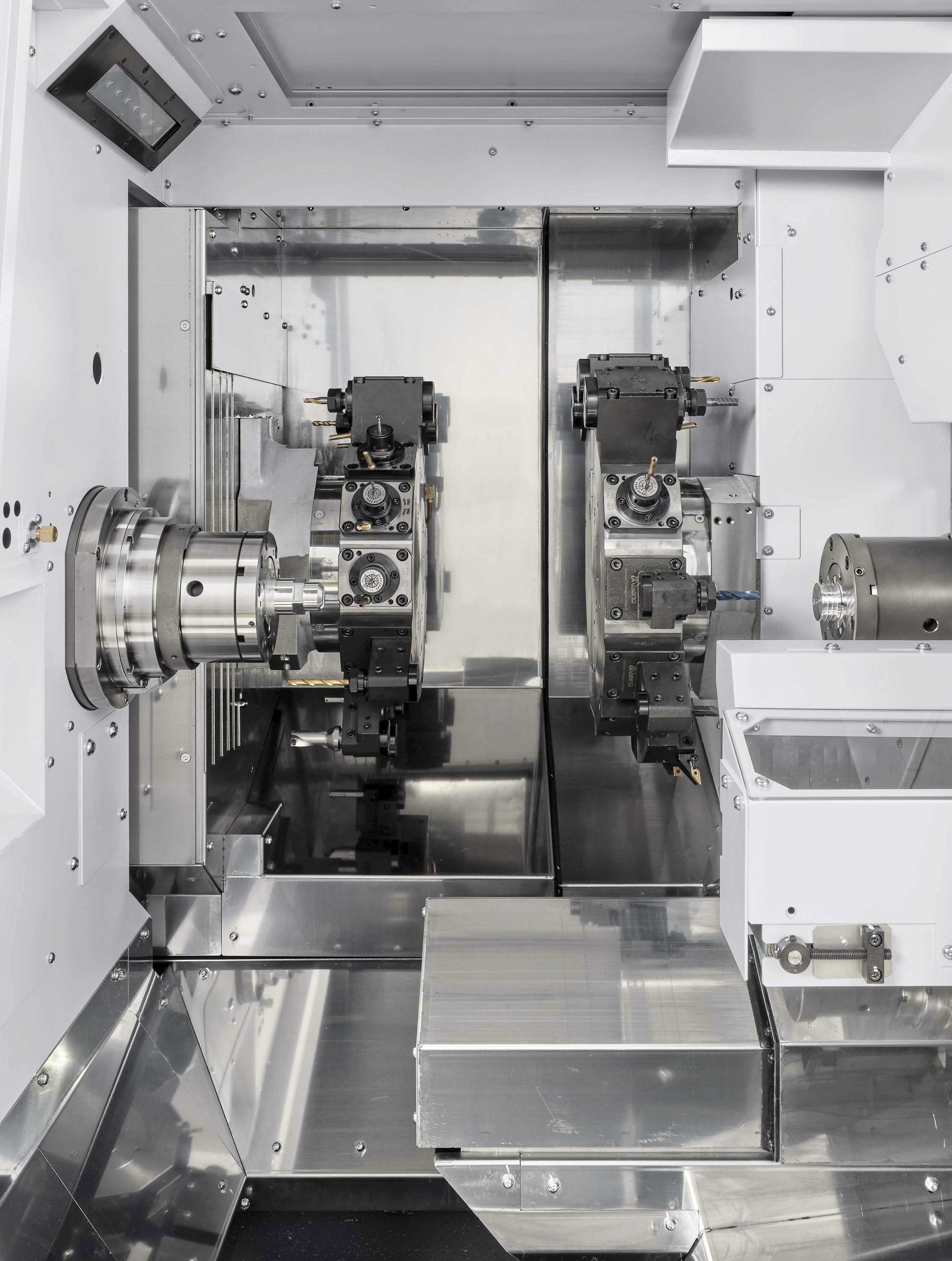
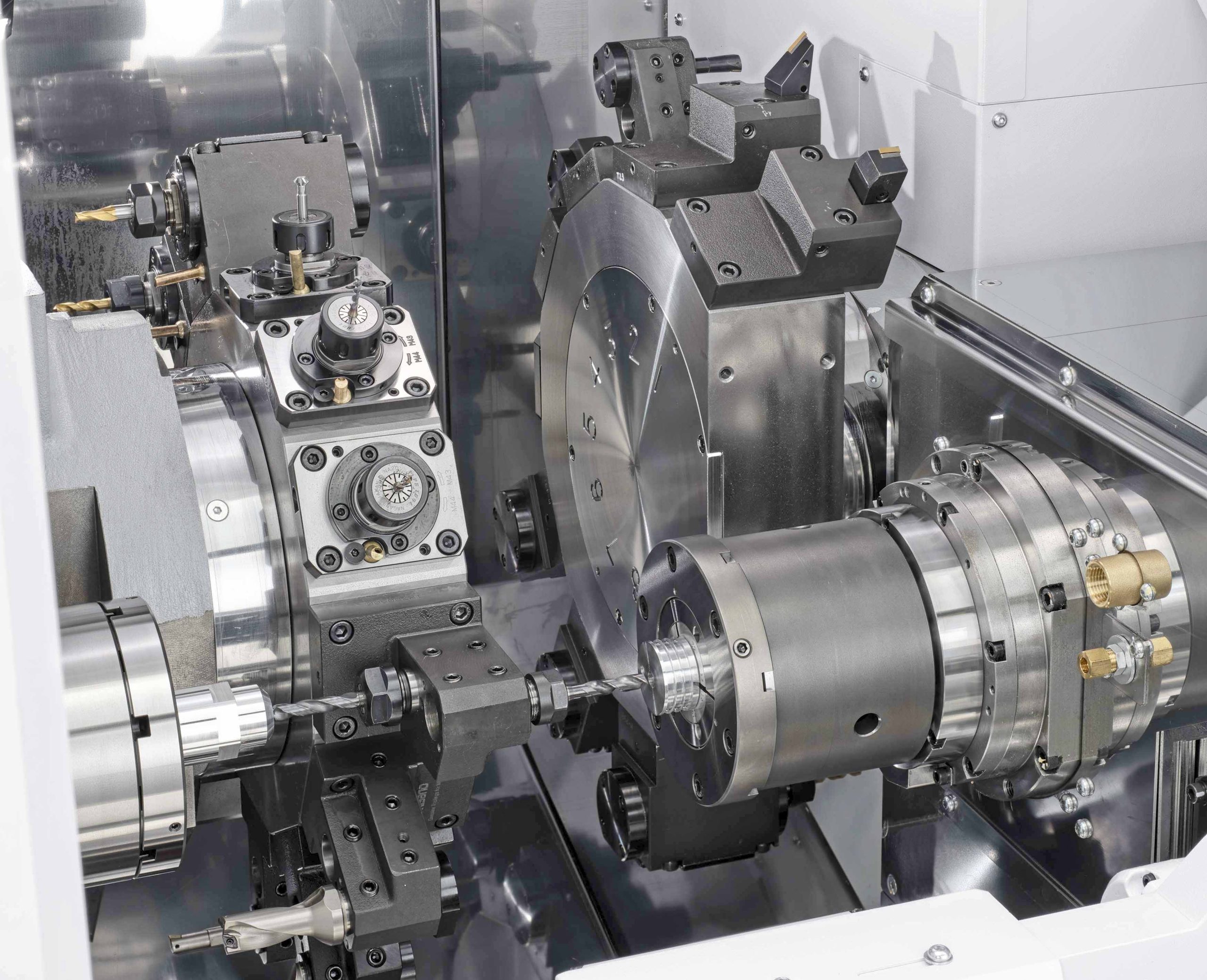

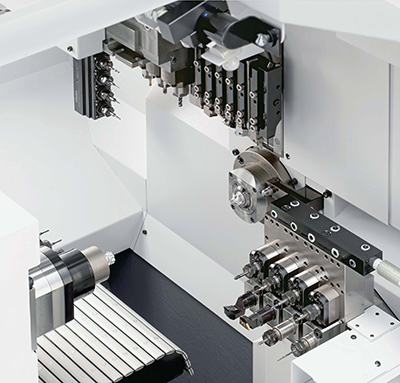 Another feature contributing to the lathe’s versatility is the ability to switch over quickly between Swiss-type operation and non-guide bush turning for more economical production of shorter components. This mode results in less bar wastage due to the shorter remnants and is well suited to coping with tight drawing tolerances and close bore-to-OD geometry. Removal of the guide bush also means that the diameter of the stock material does not have to be tightly controlled.
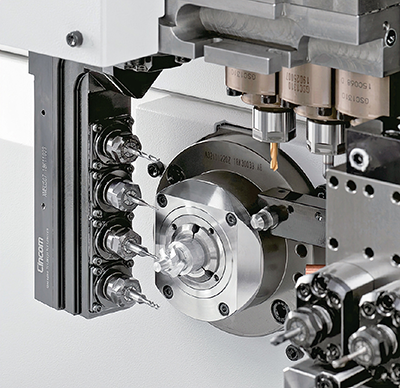 Citizen Machinery’s Eco II suite of energy-saving features are incorporated, designed to optimise power consumption, reduce compressed air usage, minimise CO2 emissions and promote environmentally friendly manufacturing practices by allowing operators to monitor and understand energy utilisation patterns.