adfield, Author at Citizen Machinery - Page 3 of 18
MOST SUCCESSFUL CITIZEN OPEN HOUSE BY FAR
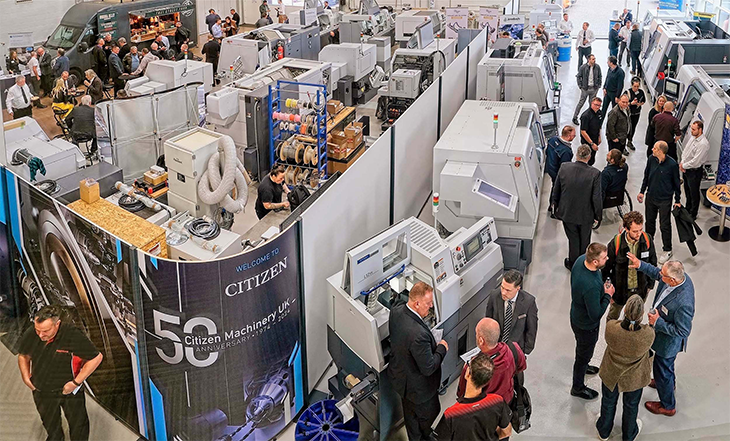
In celebration of its 50th anniversary, sliding- and fixed-head CNC lathe supplier and automation specialist Citizen Machinery UK offered visitors to its latest open house in October a 100% finance deal for machines ordered during the event. The company subsequently extended the no-deposit arrangement to the end of that month, resulting in a record order intake of 26 turning centres valued at £4 million.
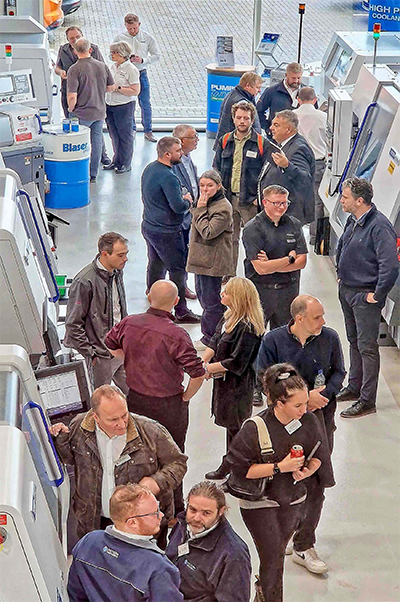
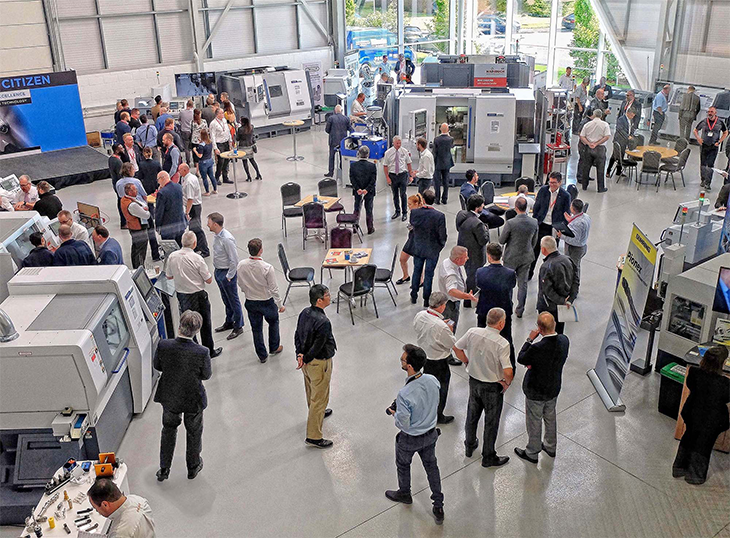
Over the three days, 190 customers representing 86 manufacturing companies were welcomed through the door at Citizen’s Brierley Hill turning centre of excellence, a 40% increase on the number that attended last year. In time for the event, the open-plan showroom on the ground floor was reorganised into three separate areas to amalgamate different functions on one level.
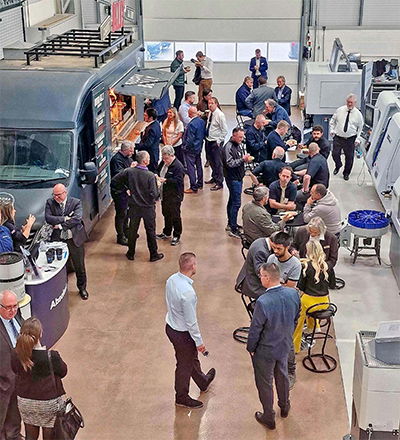
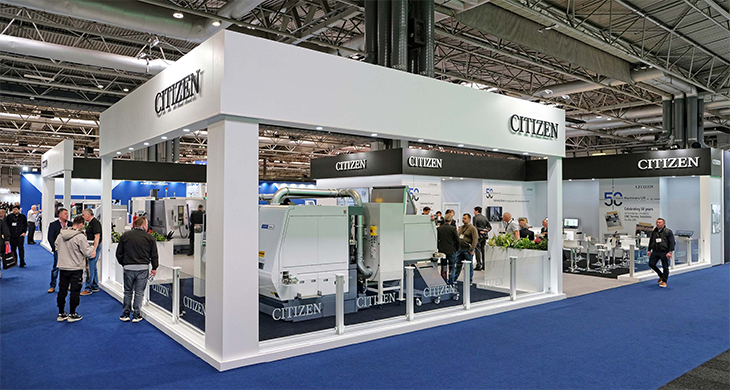
The area at the front is a demonstration facility, with around nine Cincom sliding-head and Miyano fixed-head bar-fed CNC turn-milling centres permanently under power. It has been designed to replicate on a permanent basis the company’s stand at MACH 2024. In the centre is a pre-delivery inspection facility where lathes are prepared for delivery to customers. The final area is an innovative catering zone that hosts the best of the different culinary outlets that the local area has to offer.
Highlights of the show this year were cutting demonstrations on all nine machines in the showroom, Citizen’s Eco Function touchscreen monitor for lowering users’ power consumption, automatic tool change on a 32 mm capacity Cincom, Industry 4.0 compatibility of all Citizen lathes, and of course the manufacturer’s now legendary LFV chip breaking technology that for the last seven years has helped so many users increase productivity, especially when running lights-out. Video demonstrations of robotically-optimised processes and in-cycle laser cutting capability that can be added to selected turning centre models were also showing.
As usual, supplier companies were there with stands exhibiting workholding equipment, cutting tools, probing, parts handling, barfeeds, coolant and high pressure delivery systems, filtration, dust and fume extraction, CADCAM and production control software, material suppliers, and more. Again, the number present was another record at 25.
Citizen Machinery to hold 50th anniversary open house
Sliding- and fixed-head bar turning machine supplier Citizen Machinery UK will hold an open house from 8th to 10th October 2024 at its Midlands facility, where the company has its main showroom and configures turnkey production solutions, frequently with automation, for delivery to customers. For this reason, the centre in Brierley Hill is called Citizen Machinery’s Turning Centre of Excellence, which opened in 2019 to complement the headquarters and technical centre in Bushey, Hertfordshire.
The event will mark the launch of a new version of the company’s best-selling sliding-head turning centre, the Cincom L32, which can now be equipped with an optional B-axis automatic tool changer for flexible machining of complex workpieces up to 32 mm (optionally 38 mm) in diameter.
2024 is a key milestone for the company, as it is half a century since Citizen’s Cincom sliding-head lathes were introduced to the UK and Ireland by NC Engineering, while it is 41 years since Macro Machine Tools started selling Miyano fixed-head lathes into the same markets. Both former agents were subsequently acquired by Citizen Machinery Japan.
As well as looking back on its past achievements, the Citizen Machinery UK team will showcase a variety of cutting-edge CNC turning technologies through a series of live demonstrations. Centre stage will be the company’s ground-breaking LFV programmable chip breaking technology embedded in the operating system of the control on selected lathe models, including the new L32. The benefits of not having ribbons of swarf tangled around the workpiece and tool, in terms of avoiding damage to both and raising productivity, cannot be overstated.
Another focus will be on Eco Function, an energy‐saving technology that lowers power consumption and speeds return on investment in Citizen lathes. It is characterised by the touchscreen Eco Monitor, which constantly displays in graphical form the power drawn and regenerated to ensure the lathe always runs at peak efficiency.
Best-ever MACH for Citizen Machinery
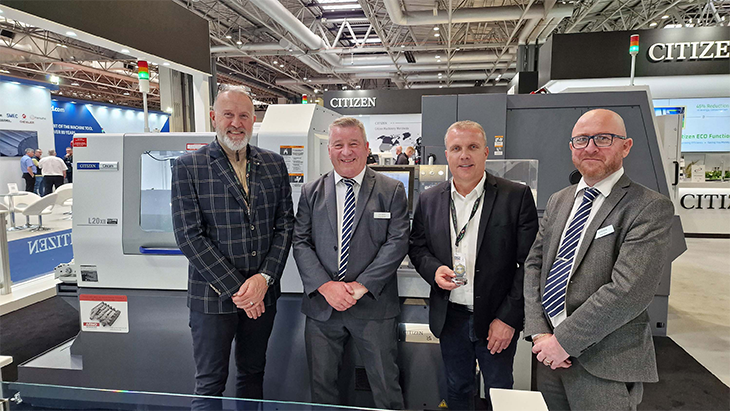
Citizen Machinery UK’s stand at MACH was busy right from the opening on the Monday morning and over the five days, 538 manufacturing companies made enquiries requiring further action. The level of visitor interest was especially high, as Citizen had decided to defer a 5% price increase on its Cincom sliding-head and Miyano fixed-head lathes until after the show. A total of 29 orders valued at very close to £5,000,000 was placed either during the event, or afterwards as a direct result of it.
All nine machines exhibited, spanning the bar capacity range 12 mm to 80 mm, were under power and five of them made separate parts that were assembled by visitors into a giveaway component. Star of the show was the Miyano BNE-65MYY, which employed the versatility of Citizen’s superimposed machining to produce an impressively complex part in about 2.5 minutes. Robotic automation on a Miyano BNA-42SY5 was another highlight, while the Cincom L32-XLFV utilising the company’s LFV chip breaking technology to cut plastic also created a lot of interest.
Now that MACH is over, thoughts have already turned to the annual Citizen open house in October, where the company will continue to celebrate its 50th anniversary.
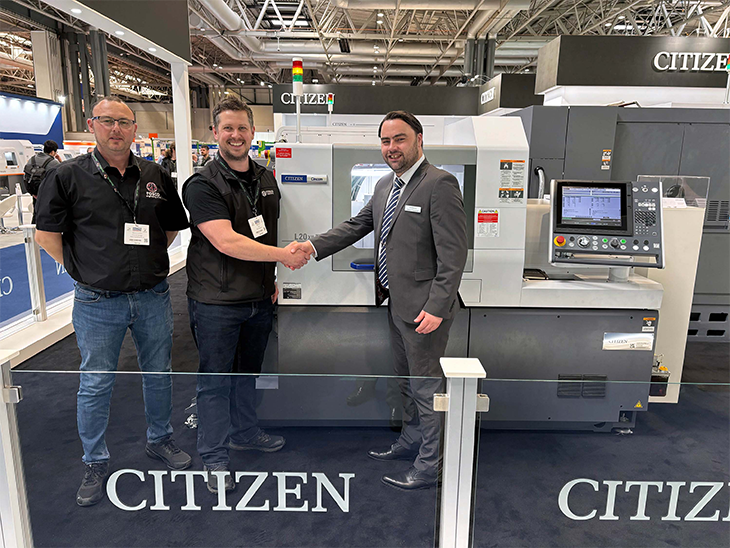
Richhill-based subcontractor Rosco Engineering in Co Armagh was quick off the mark on the Monday morning, placing an order for a Cincom L20-XIIB5LFV sliding-head lathe. Production of hydraulic parts, which accounts for 15% of the company’s turnover, is a price-sensitive undertaking. The company was delighted when in 2006 its first Citizen lathe, a larger capacity L32, reduced a three-operation process taking seven minutes to a single, four-minute cycle. The time to produce this 303 stainless steel part should be reduced by a further 50% by the smaller, more nimble L20, doubling productivity.
General manager James Scott commented, “Not only will the new slider be more productive, but it will also save an extra shift, adding to the financial benefit. We machine a lot of stainless steel and plastic in addition to mild steel, so Citizen’s low frequency vibration (LFV) function will help with chip breaking, while high pressure coolant will ensure uninterrupted production of parts requiring deep hole drilling. Both swarf management techniques should significantly extend tool life.”
It is notable that although the L20 is nominally a 20 mm bar capacity machine, it will accept stock up to 25.4 mm diameter, a feature that comes into play in this application. The highly specified lathe also has extra toolholders and a swivelling B-axis tool carrier that extends the machine’s versatility when executing angled cross-working or end facing operations.
Of the seven Citizen lathes operated by Rosco Engineering, three are from the supplier’s fixed-head Miyano range. They include a BNA-42GTYLFV capable of superimposed machining with three tools in cut simultaneously. When installed in 2017, this machine was also able to halve production time for a part requiring a lot of milling from four to two minutes.
Located in Billericay, Southfields Engineering is another subcontractor that placed an order on the Citizen Machinery UK stand on the Monday morning at MACH, this time for an L20-VIIILFV sliding-head lathe. A user of a 65 mm capacity Miyano fixed-head lathe and a Cincom customer since 2011, the company was keen to replace an early A20 sliding-head lathe with a modern model capable of much higher productivity.
Director Russell Sullivan said, “We started out 30 years ago making parts for mobile phone masts, which still accounts for about 20% of turnover. The arrival of the A20 13 years ago was a revelation, as it transformed the production of a capacitor holder for a magnetic resonance imaging machine. It formerly took four minutes to machine in two ops on an Acromatic plugboard lathe plus one on a mill, whereas on the twin-spindle Cincom it was complete after one 48-second turn-milling cycle.”
Co-director John Barrett added, “The new L20 will result in a substantial further increase in productivity, helping to amortise the capital cost quickly. The Cincom L12 we bought in 2016 paid for itself within 18 months. It will be a similar story with our Miyano BNE-65MYY fixed-head turn-mill lathe, which has replaced an older ABX model and is a full 30% more productive.”
Business has grown over the years to the point where the subcontractor currently receives a lot of work from the medical, lighting and catering sectors. A range of materials is processed, from steels through titanium and nickel alloys to plastics. Many of these benefit from LFV chip breaking in the two latest Cincoms, which is switched on for parts of cycles when stringy swarf would normally be generated. It avoids having to stop the lathes to clear the swarf and is consistent with long periods of unattended production, helping to keep 150,000 parts going out of the door on schedule every month.
AEROSPACE TURNED PARTS SUBCONTRACTOR RAISES PRODUCTION EFFICIENCY WITH TECHNOLOGY FROM CITIZEN
Founded in 1965, subcontract machining firm Apel specialises in the manufacture of precision components for the aerospace industry. The company began investing in Citizen CNC turning centres in the 1980s to help raise efficiency and over time has continued to re-invest in modern, highly productive lathes purchased exclusively from Citizen Machinery UK.
Today at its Wilmslow facility, Apel operates nine Cincom sliding-head lathes and one Miyano fixed head model. Together they produce around 50,000 components per month across more than 3,000 part numbers. Utilisation of these Citizen CNC lathes and related technologies has led to much increased levels of productivity and profitability.
The technology that has contributed most to raising efficiency of production at Apel is Citizen’s proprietary LFV (low frequency vibration) chip breaking software, which is part of the operating system in the control of three of the six 20 mm capacity Cincom L20s on site. When activated, the function breaks what would otherwise be long, stringy swarf into short, manageable chips. Around 50% of material processed by Apel is aerospace grade stainless steel bar and LFV is especially effective when processing this alloy.
Paul Bowker, Apel’s quality director said, “We were an early adopter of LFV in 2018 following a visit to Citizen Machinery’s technical centre in Bushey to witness demonstrations.
“The function reduces metal removal rate slightly, so we don’t use it all the time, but it’s really useful to be able to pick and choose when to program the function to start and stop.
“We switch it on mainly when turning stainless steel components on the LFV-equipped machines, especially when processing parts shorter than one inch (25.4 mm). It is normally chip breaking the metal for up to half of a typical cutting cycle.”
He further explained that the decision to use LFV is also based on the surface finish required on components. Some customers’ drawings stipulate a very high surface tolerance and machining with the LFV function switched on allows this to be achieved by turning alone, avoiding the need to centreless grind parts afterwards, thereby reducing unit manufacturing cost and raising profitability. Dimensional and surface finish tolerances on many component drawings can be met and maintained when using this facility.
Apel also uses the Citizen Machinery’s adaptive guide bush (AGB) system, which automatically compensates for variation in bar diameter, preventing stock seizing in the bush. It also constantly maintains concentricity to prevent run-out. Downtime is avoided and tight machining tolerances are maintained. The system is used not only on the 20 mm capacity sliding-head lathes but also on three 32 mm capacity Cincom models on the shop floor.
The aerospace sector is very busy presently and Apel is well placed to win work due to the quality management system it operates, competitive pricing and the many industry and customer approvals it holds. Exports account for 20% of turnover, with India and Saudi Arabia being major overseas markets.
The AGB systems ensure reliability during unattended operation by compensating for bar diameter inconsistency and preventing stoppages. Additionally, the LFV machines do not have swarf clogging the working area when processing stainless steel. It contributes further to reliability and eliminates the need for an operator to be in attendance to untangle ribbons from the components and tooling.
Mr Bowker concluded, “Our nine Cincoms, as well as the Miyano for turn-milling larger components up to 50 mm diameter, support all of our production and will continue to do so as we increase our volume of work in the expanding global aerospace industry.”
RAPID SET-UPS DECIDE SLIDING-HEAD LATHE PURCHASE
Last autumn (2023), motorsport subcontractor h2m (www.h2mengineering.co.uk) needed to replace an ageing sliding-head CNC turn-mill centre in its Hinckley factory. Joint managing directors and owners, father and son team Andy and Martin Forryan, considered buying a replacement from the supplier of the original twin-spindle, 32 mm capacity slider, but opted instead for a Cincom M32-VIIILFV from Citizen Machinery.
3,000-off is a large run for sliding-head turned parts at h2m, while production of batches of relatively simple components up to 500-off is typical for unattended overnight running. However, trickier jobs are completed during day shifts in batch sizes as low as 10-off, so speed of programming is essential to minimise machine downtime. Otherwise the reduction in productivity would lower profitability.
One benefit of the M32 that Mr Simms appreciates is the lathe’s spacious working area, which facilitates and speeds set-up for the next batch run.
Andy and Martin paid particular attention to this issue and came to the conclusion that the Cincom lathe with Citizen’s Alkart Wizard programming system would be less expensive and several times faster than if the other lathe had been purchased. The wizard assists and simplifies the creation of even complex cycles using a built-in code library, reference material and diagrams.
Sharing some detail of their deliberations, Martin said, “Alkart Wizard is an inexpensive option. We use it to prepare programs and prove them out off-line for virtually every sliding-head part we produce. Only the occasional simple component is programmed directly at the control.
“Even complicated components take just 30 to 40 minutes to program in Alkart and it then takes 15 to 20 minutes to high-speed check the cycle virtually in the wizard, so a new job is always up and running in under an hour.”
He contrasted this with the much longer and more expensive route that would have been needed with the other slider, for which a similar wizard was not available. First, it would have been necessary to purchase a sliding-head turning software licence for h2m’s seat of EdgeCAM, as well as a post processor for the lathe.
Furthermore, creation of the program would have been longer before it could be downloaded to the control, added to which checking the cycle by hand on the lathe would have been very time-consuming, tying up the machine for several hours if it was a complex part. The alternative would have been to acquire third-party verification software, again entailing extra cost. Even then, program creation and prove-out would have taken considerably longer.
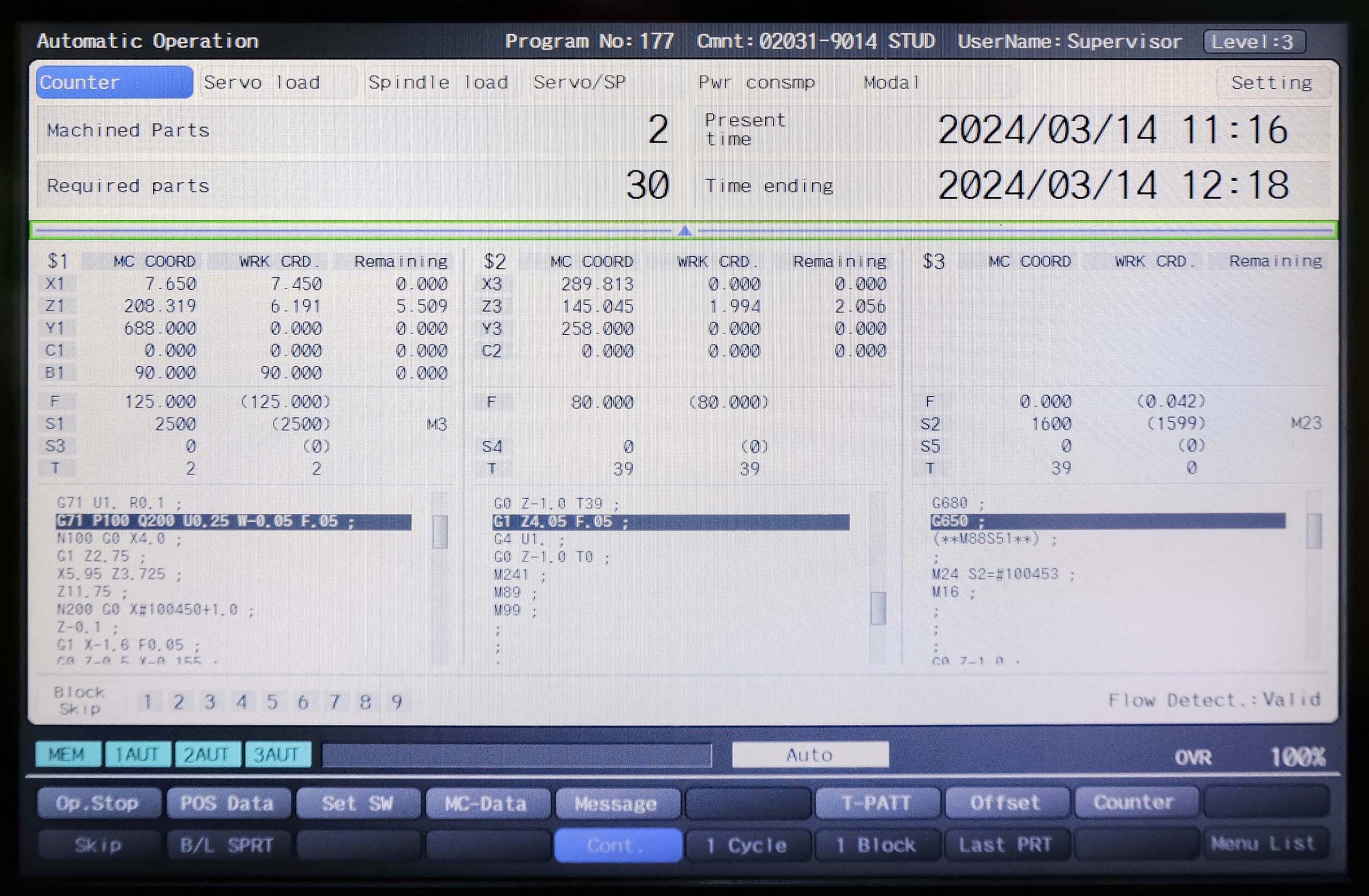
The Cincom control screen, showing a relatively short run of 30-off in progress. This relatively simple part takes about two minutes to produce, but some complex components can take up to a quarter of an hour.
Jack Simms, setter-operator of the M32-VIIILFV added, “Basically, the Alkart Wizard is a CAM system and post processor for the Cincom lathe all in one. It is very quick to use and the next program is always ready as soon as the previous batch has finished.
“We also like the LFV (low frequency vibration) chip breaking software in the lathe control, which is built into the operating system rather than being macro-based.
“It works at both spindles and is an absolute dream. We use it on most jobs, mainly for G71 roughing cycles which tend to produce stringy swarf, particularly when machining heat-treated stainless steels and titanium.
“LFV is programmed by G-code to turn on when roughing starts and off again when it finishes and is typically used for one-quarter of a cutting cycle. You always end up with short chips, so there are no ribbons tangled around the tool and part.”
Everyone at h2m agrees that the Cincom is a stable, repeatable machine that produces parts to within 10 µm total tolerance all day long – and to within 5 µm with operator supervision. The machine was supplied with a kit that allows oversize bar up to 35 mm diameter to be fed into the machine for sliding-head mill-turning. A further benefit is the ability to remove the guide bush, enabling parts up to 2.5D to be machined more accurately from less expensive bar, in multiple passes if desired, while reducing remnant length threefold. Neither facility had been used by the time the firm was visited in mid-March 2024, by which time 74 different components had been produced on the M32-VIIILFV.
The machine has rapidly proven to be a key facility on the turning side of the subcontractor’s business, supplementing CNC milling, much of it automated, as well as both die-sink and wire-cut electric discharge machining. The latest lathe acquisition is helping to further the subcontractor’s success, which is already evident from its current headcount of 49, despite the company having been established by Andy Forryan as recently as 2015. Today, 80% of the firm’s throughput is destined for the motorsport sector, but aerospace work has started to grow and the company is already an established tier-two supplier.
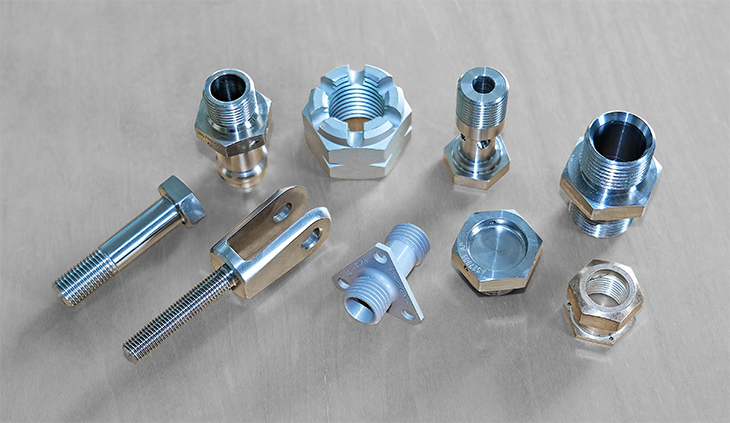
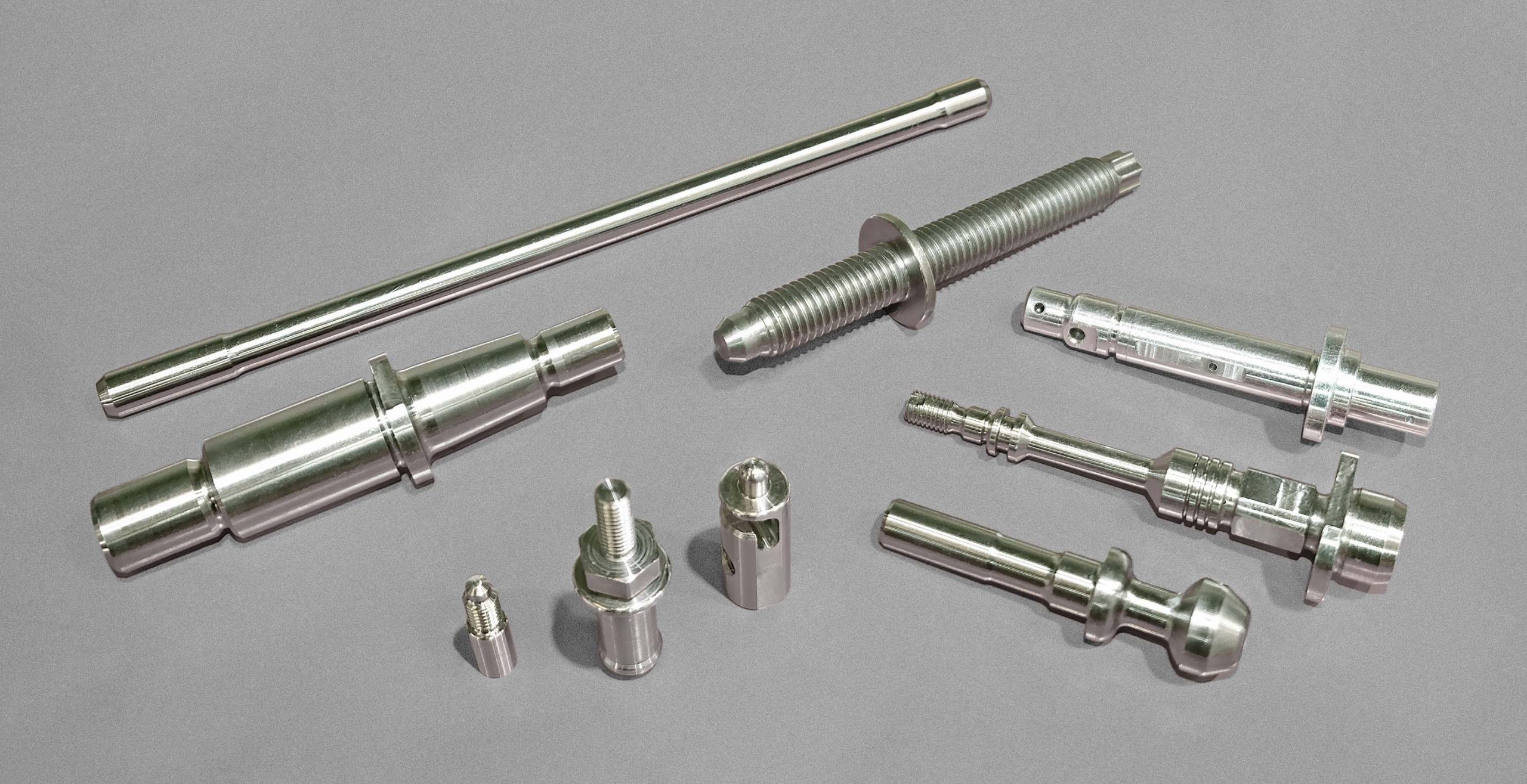
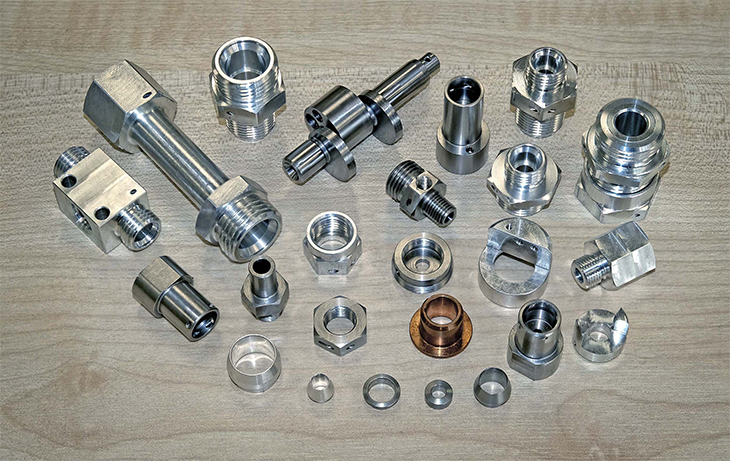
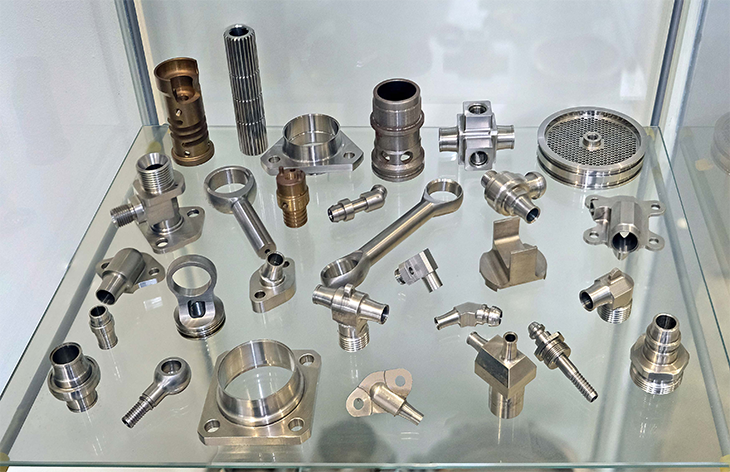
A selection of components produced by h2m on the Cincom M32-VIIILFV.
MACH 2024 Preview – Hall 20 Stand 361
Citizen Machinery will reaffirm its position not only as the leading supplier of bar-fed lathes into the British and Irish markets, but also as a pioneer in implementing attendant technologies that take that pre-eminence to the next level in terms of innovative production. The company’s patented LFV (low frequency vibration) chip breaking software, its wealth of options for automating production, and integral laser cutting in its Cincom sliding-head lathes are three examples.
The focus will be on Citizen’s proprietary LFV operating system software that ensures efficient chip breaking and every sliding-head mill-turn centre on the stand will have this functionality (Hall 20, stand 361). 2024 marks the sixth anniversary of the technology’s launch.
It has had a transformative effect on sales of Cincom sliders around the world, and also of selected models within Citizen’s fixed-head Miyano turning centre range, owing to the superiority of chip breaking over that achievable with conventional pecking macros and dwells. That is especially the case when machining stainless steel, aluminium, copper, various exotic materials and plastics. There is also a noticeable improvement in tool life and surface finish due to the avoidance of recutting of chips.
Problems arising from stringy swarf entangling around the workpiece and tool are prevented by vibrating the X and Z servo axes in the direction of cutting in synchrony with rotation of the spindle. The function, which has three alternative modes, may be used with static and driven tools. It is especially helpful in generating manageable chip sizes when grooving, drilling deep, small-diameter holes, and internal and external thread cutting.
Sliding-head lathe tailored to medical component production
Visitors to the Citizen Machinery UK stand will learn that the configuration of the 12 mm bar capacity Cincom L12-X ideally suits it to the production of dental abutments and implants, as well as medical industry parts in general. Multiple rear-facing endworking tool positions including driven stations are provided, as well as a Y2-axis to the X2 and Z2 movements on the counter spindle to match the three degrees of freedom on the main spindle.
A modular tooling system has been adopted for the gang and back tool posts and an extensive variety of tooling layouts is possible, which includes the ability to drill angled holes. The maximum number of tools that can be deployed is 38. Unlike on other Cincom L12 models, a built-in 12,000 rpm motor drives the counter spindle, reducing acc/dec times for higher productivity. Rapid traverse in all axes of 35 m/min contributes further to minimising idle times.
32 mm capacity sliding-head lathes
Two Cincom lathes on the stand will have 32 mm bar capacity, including the L32-VIII, which accepts 38 mm stock if the guide bush is removed. It is one of four machines with exclusively gang toolposts in a modular range that allows a user to select a precise specification to suit the intended applications, while retaining the option of adding extra functionality later. The version on show will be a 7-axis model with up to 30 tools, said to have an excellent cost-performance ratio.
The other model is Citizen’s flagship sliding-headstock lathe, the 15-axis Cincom M32-VIII, now in its fifth design iteration. A 10-station turret, which runs on hardened box ways, incorporates a tooling system employing a single, heavy duty, 2.2 kW drive to power the live cutters. The gang tool post has been equipped with live tools powered by a 2.2 kW motor, as well as a programmable, 9,000 rpm B-axis to enable simultaneous machining in five CNC axes, while the back tool post with Y-axis has adjustable-angle tooling. Three tools may be in cut at the same time, supported by the Mitsubishi M850W control with 15-inch touch-screen HMI, shortening cycle times and raising productivity.
The lathe’s ecological credentials, as with other Citizen machines, are impeccable. The M32 is an environmentally friendly product that has undergone stringent assessment by the manufacturer. The use of easily recyclable materials and avoidance of hazardous substances are combined with Eco Function hybrid technology that automatically saves energy through the intelligent use of power during non-cutting periods.
Triple Y-axis turret lathe
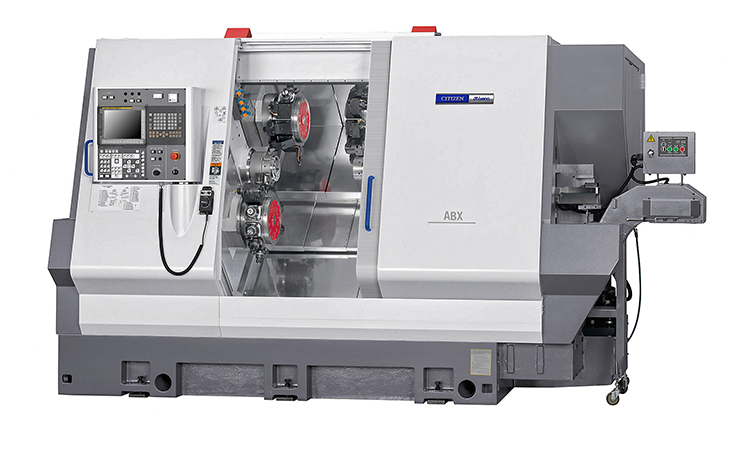
One of the larger bar capacity CNC lathes in the Citizen Machinery product portfolio is the 12-axis Miyano ABX-64THY, a fixed-head model with twin-opposed C-axis spindles and three turrets moving over box ways for maximum rigidity. The turning centre is ideal for continuous, automated, unattended production of components from bar up to 64 mm in diameter. Maximum component diameter when chucking is 165 mm. Rapid traverse rates are fast at up to 30 m/min in Z, promoting short non-cutting times.
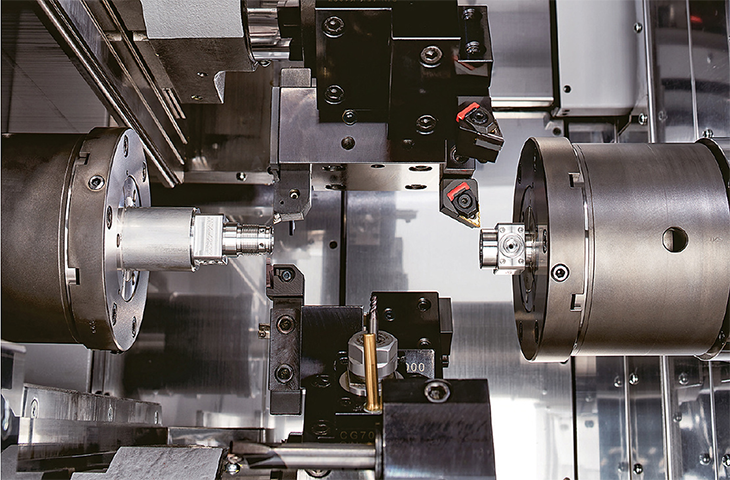
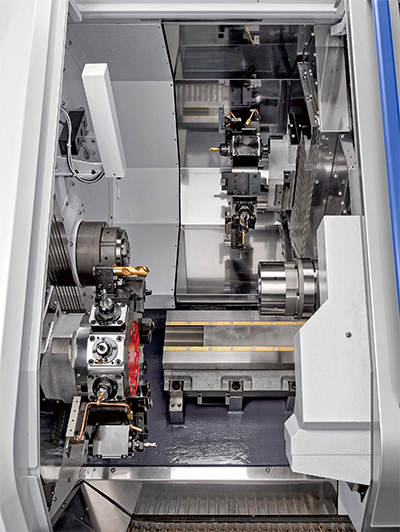
The three turrets, which have 80 mm of Y-axis movement, can all be in cut simultaneously to achieve very high levels of productivity. Two turrets are positioned above the spindle centreline and are dedicated to working at the 15 kW / 2,750 rpm main spindle and 7.5 kW / 5,000 rpm counter spindle respectively. The other turret is located below and has unrestricted travel to operate at either spindle to provide flexibility for balancing front and reverse end machining operations, or to deploy a tailstock centre to support shaft-type components being machined in either spindle.
Temperature variations around the machine are constantly measured by sensors and fed back to the Fanuc Series 30i-B control, which incorporates software to compensate for thermal movement by adjusting the relevant axis positions. In this way, displacement of the turret from the main spindle in the X-axis, for example, is reduced from 30 down to 10 microns. An in-machine tool setter, parts catcher and conveyor, and a variety of different swarf conveyors to suit the type of chip are all available.
Double Y-axis fixed-head lathe with Fanuc control and LFV
The first fixed-head lathe in Citizen Machinery’s Miyano range to have the company’s patented LFV chip breaking software in a Fanuc control system was the 42 mm bar capacity ANX-42SYY. It features 10 CNC axes including a ± 35 mm Y-axis on both the upper and lower turrets in addition to X- and Z-axis movements, enabling the production of complex components to tight geometrical tolerances.
The compact mill-turn centre is ideal for OEMs and subcontractors keen to leverage the quality and productivity of a Miyano lathe and at the same time standardise on Fanuc controls on their shop floor for the sake of operator familiarity and compatibility with other machines. The 15-inch XGA (extended graphics array) touch panel Fanuc 31i control features a new Citizen HMI and incorporates the company’s multi-axis technology.
The 6.2-tonne machine occupies only 2,650 mm x 1,630 mm of space on a shop floor. Both main and sub spindle have a bar capacity of 42 mm diameter and are powered by 11 kW / 6,000 rpm built-in motors. The turrets have 12 live tool stations each rated at 6,000 rpm / 2.2 kW / 20 Nm. Rapid traverse rates are fast at up to 30 m/min, again with high productivity in mind. This has been achieved by adopting linear guides in all axes. Commonality of tool holders with Citizen’s popular BNA range of Miyano lathes leads to cost savings for existing users of the supplier’s equipment.
Turning and milling centre with two Y-axis turrets
Complex components up to 65 mm in diameter may be turned and milled from bar in a new Miyano fixed-head lathe. The eight-tonne BNE-65MYY is equipped with two turrets having Y-axis travel in addition to X- and Z-axis movements. One turret is positioned above and the other below the centreline of the twin-opposed spindles and both tool carriers have 12 live stations. A C-axis on each spindle and movement of the sub spindle in X and Z bring the bar auto’s CNC axis tally to 10.
The two-axis movement of the sub spindle facilitates superimposed machining, whereby tooling on both faces of the top turret can simultaneously cut front-end features on the bar stock and reverse-end features on a parted-off component. With the lower turret also working at the main spindle performing pinch turning, milling or drilling, for example, or perhaps OD turning while axial drilling is in progress above, three tools are in cut at the same time.
Contributing to high productivity are fast rapid traverses up to 20 m/min, plus main and sub spindles with generous power ratings of 18.5 kW and 11 kW respectively. As both spindles rotate at up to 5,000 rpm, productive turning is maintained even when machining smaller diameter sections of a workpiece. Rotary tool specification is also impressive at 4 kW / 6,000 rpm.
Control is by the Mitsubishi M830W, which has a new HMI with a 15-inch touch-screen control for convenient operation, including on-screen selection of the turret tooling. Intelligence built into the control simplifies programming, especially of superimposed cycles by automatically synchronising those sections of the program.
Mill-turn centre prepared for automation
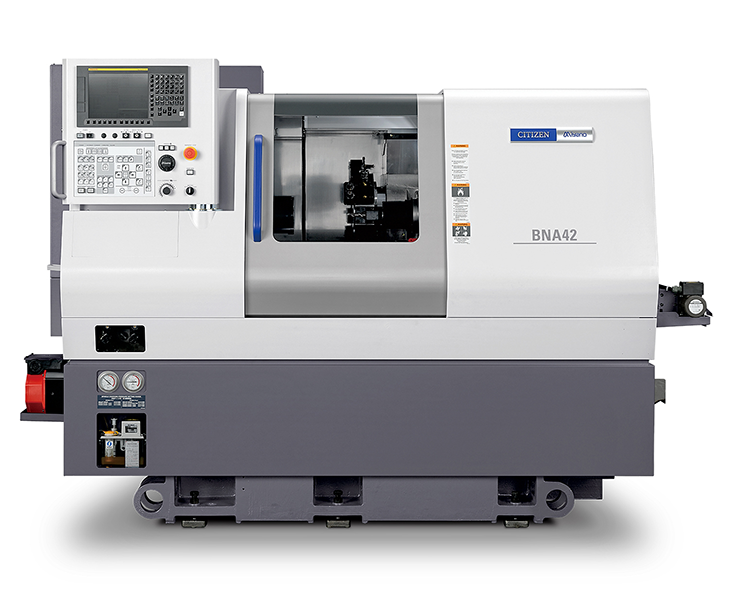
Building on the strengths of previous generations of Miyano fixed-head mill-turn centres, the BNA-42SY is one of Citizen Machinery’s latest additions to the range. The CNC lathe is the first BNA model to have a 12-station turret giving ± 35 mm of Y-axis movement, all tool positions now being live, and a new design that lends itself to easy automation. The latest FANUC 0i-TF Plus CNC system with 10.4-inch colour LCD screen controls the machine.
The rigid, 1,823 kg bed brings thermal control advantages. The base casting has been prepared with space at the right hand side for robotic load / unload equipment. If a user intends to take advantage of automation, the machine can be supplied with a swarf conveyor that exits to the rear as an option.
The automation may be employed solely for unloading components that have been mill-turned from bar stock up to 42 mm diameter, either directly from a spindle or via a parts catcher and conveyor. Alternatively, or in addition, it may load and unload billets or near net shape workpieces like castings or forgings up to 135 mm in diameter. A workpiece stocker is positioned at the right hand side of the machine to accommodate the finished components.
Mounting points have been included to provide an option to add an overhead gantry if only chucking is to be carried out, in which case a raw material stocker can be positioned to the left of the machine in place of the bar magazine. For complete flexibility in layout, top shutter and auto door options are offered.
Use of an inverter-controlled, hydraulic unit results in a large reduction in power drawn. Standby power consumption is just 0.661 kW, as servomotor readiness is automatically turned off when it is not needed, for example during program editing. Overall energy consumption can be visualised via a power monitor window on the control screen.
Improved production efficiency in a small footprint
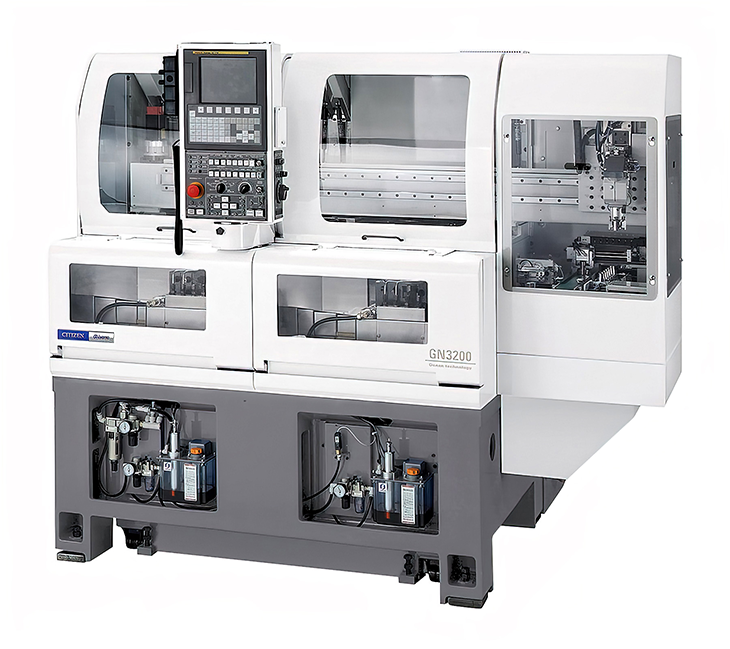
The GN3200W is a twin-spindle, fixed-head lathe equipped with a high-speed loader for high productivity. The compact machine width is 33 percent narrower than previous Miyano models and the required floor space has been reduced by 27 percent, realising significant space saving. A wide choice of infeed/outfeed devices, single or double high speed gantry loaders, transfer and turnover units makes the machine an ideal choice to meet automation needs.
The concept when designing the machine was to prevent thermal displacement by transferring the heat generated by machining into the machine body. This is achieved by having a frame and bed with a thermally symmetrical design, backed up by a wing-type headstock and a separate coolant tank.
FABRICATOR REBALANCES BUSINESS TOWARDS SUBCONTRACT MACHINING
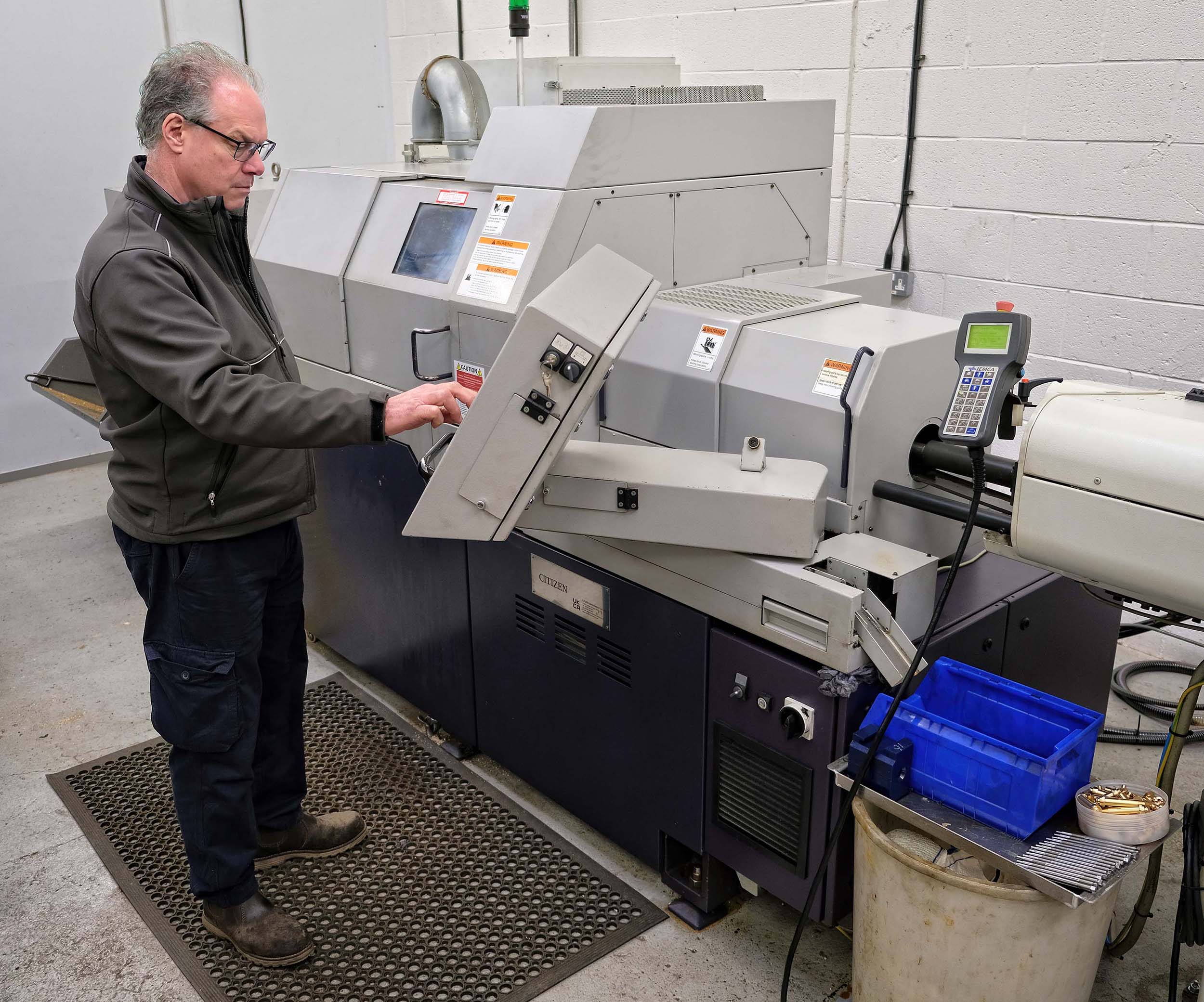
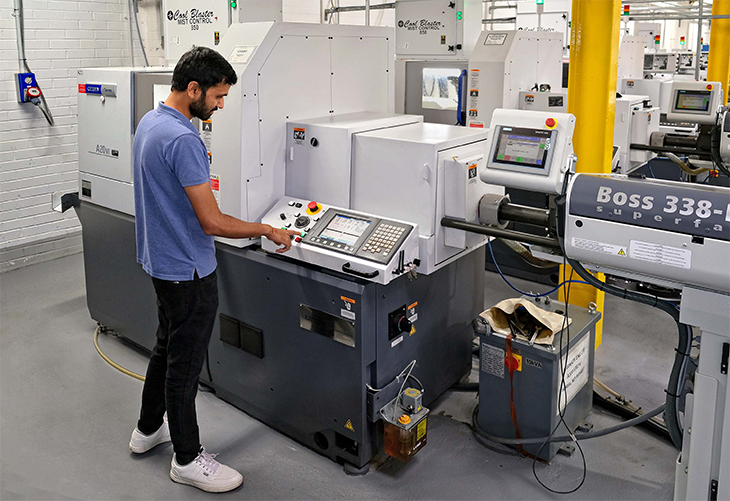
Gareth Davies, owner of TAS Engineering, operating the used Citizen Cincom L20 sliding-head lathe on the shop floor in Burton-on-Trent. The machine was supplied with an Iemca bar feeder and a CoolBlaster high pressure coolant delivery system rated at 2,000 psi.
Twenty years ago, Gareth Davies started Burton-on-Trent company TAS Engineering as a steel, stainless steel and aluminium fabrication shop serving food and beverage customers, the pharmaceutical and automotive sectors, and industry in general with fire escapes, factory staircases and secondary steelwork.
In 2014, he established a machine shop to add extra value to the products the company was shaping and welding. Today, there is a pair of 3-axis, vertical-spindle machining centres on-site and three CNC lathes, the latest of which is a second-hand Cincom L20 sliding-head turning centre from Citizen Machinery UK.
What prompted the purchase in October 2023 of this 20-year-old lathe, the company’s first sliding-head model, was a desire to turn more efficiently components in a range of materials from bar up to 20 mm in diameter. A case in point is the ongoing production since 2020 of a 16 mm diameter, 316 stainless steel magnet holder, which is welded to a small, laser-cut and bent plate to form part of a safety unit for industrial switchgear. The turned component, of which 200 are required per month, was previously produced complete on one of two fixed-head, twin-spindle lathes (that have since been sold) in a 2.5-minute cycle. Mr Davies had previous experience of programming and setting sliding-head lathes, albeit from 40 years ago working for a subcontracting firm in London that happened to be the first ever customer of the Citizen sales agency at that time. The lathes were equipped with servo-driven cams and while the technology has moved on enormously over the decades, the underlying principle of operation is still similar.
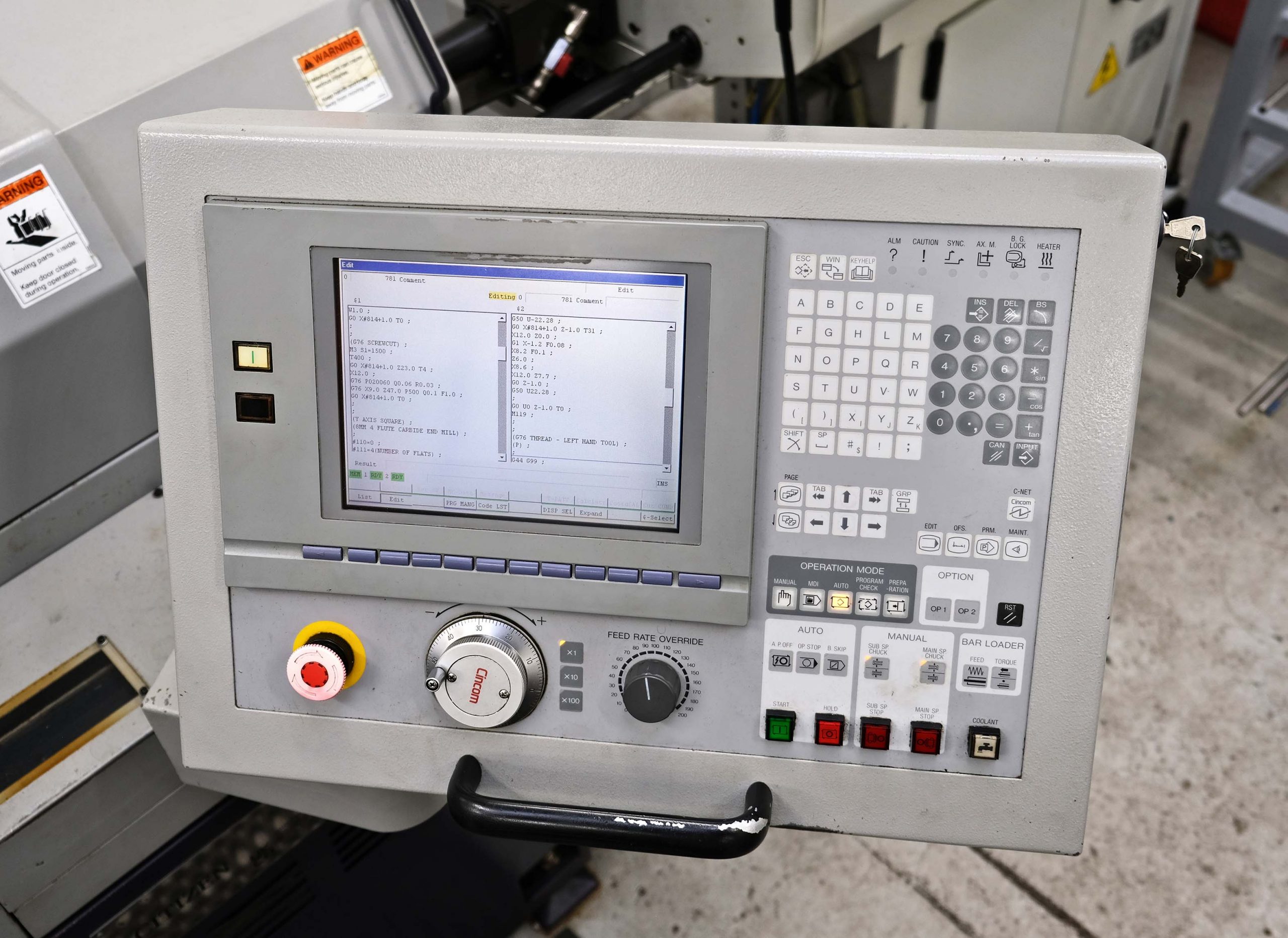
The 20-year-old control system looks surprisingly modern.
It was apparent that the steel magnet holder could be produced more quickly on a modern Citizen L20 twin-spindle, sliding-head turning centre than on a fixed-head lathe due to the faster axis motions of the gang tool carriers on the former compared with the turret movements on the latter. However, Mr Davies was surprised to find that the part could be machined more than three times faster on the Cincom, the cycle now taking just 48 seconds.
The sliding-head turning centre was installed and commissioned in October 2023, so it is still early days. Nevertheless, four additional jobs had been won by the end of the following January as a result of having the capacity available on the shop floor. None of this new work has anything to do with the fabrication side of the TAS Engineering’s business. One contract involved the production of 1,000-off brass parts for a customer in industrial gases, which ran 24/7 for one week, despite Mr Davies being new to sliding-head lathe operation.
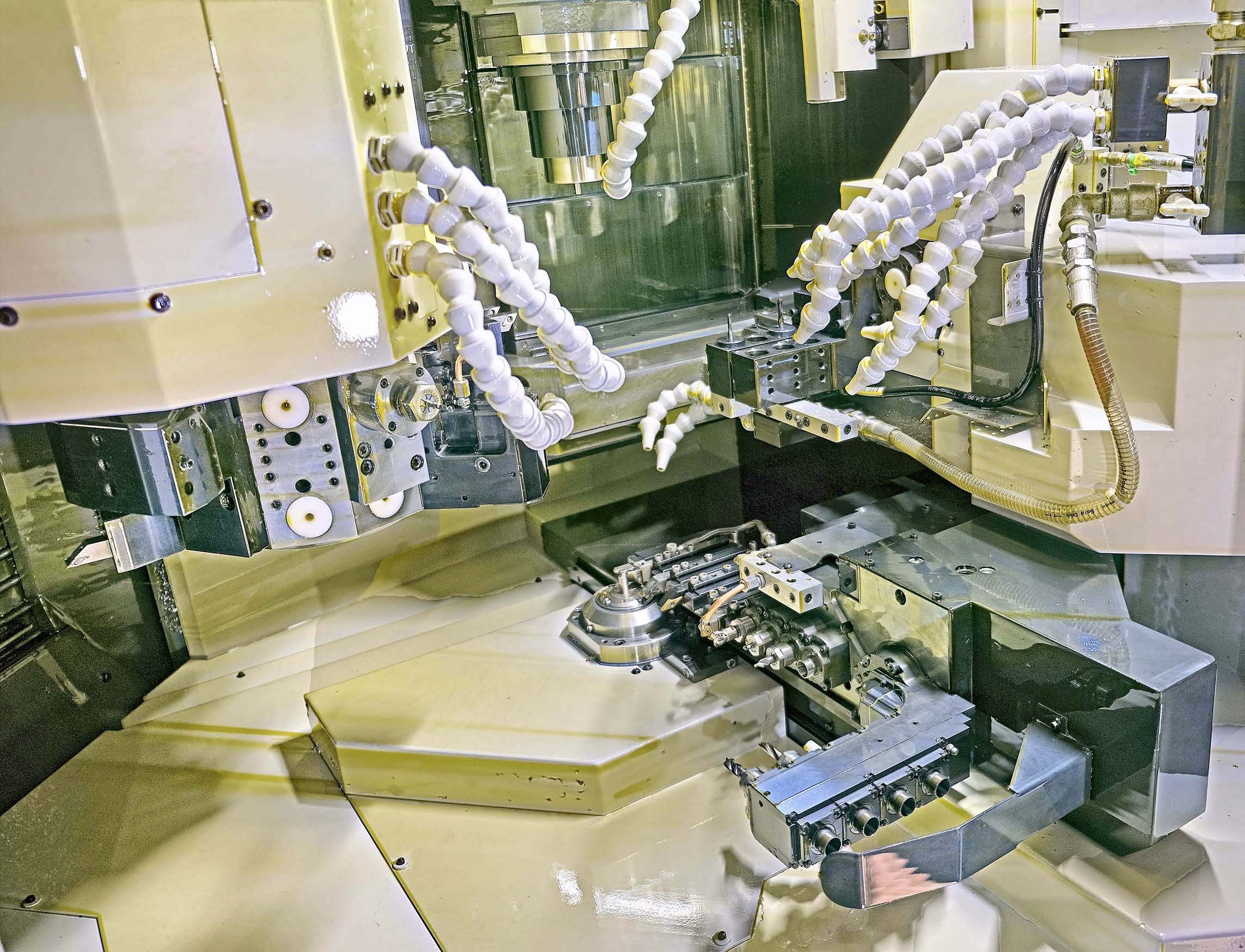
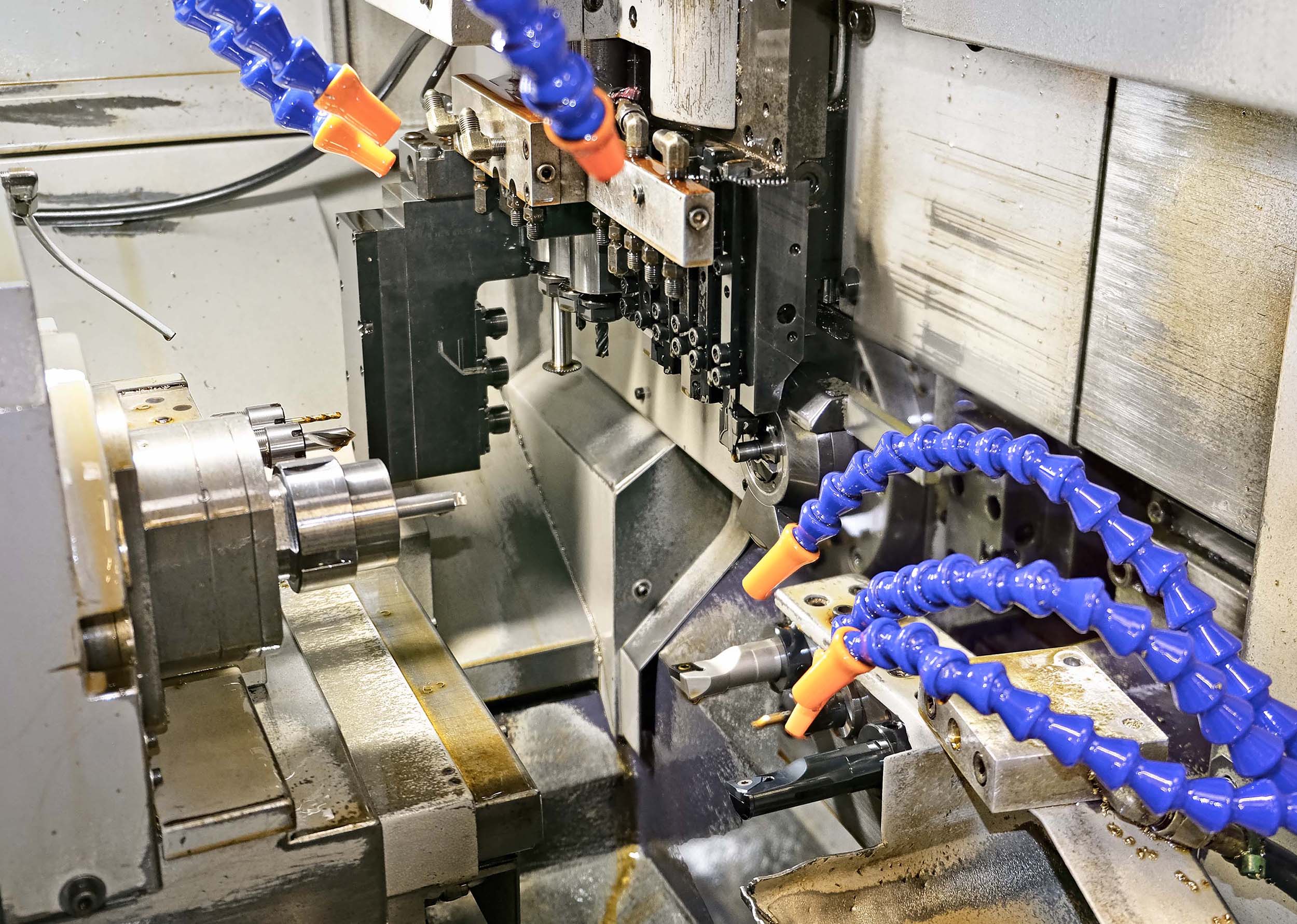
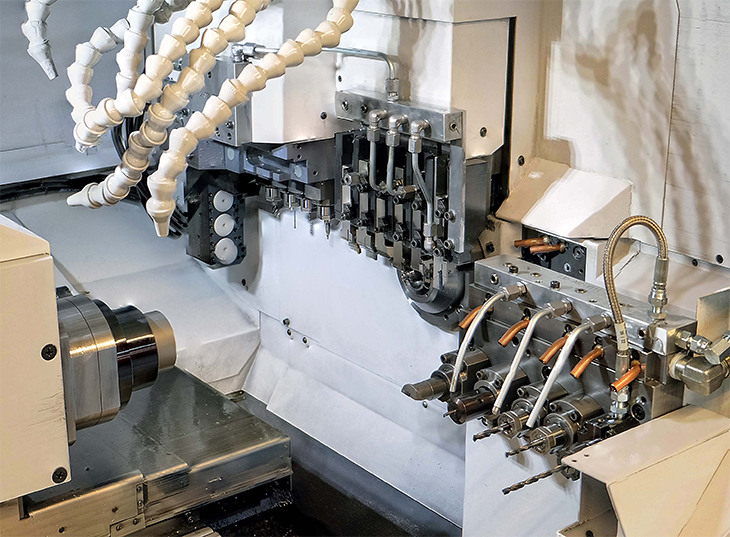
Working area of the Cincom L20, showing the gang tooling and sub spindle on the left opposing the sliding-headstock unit.
The other jobs were 70-off engine parts produced from steel bar in one hit rather than in two operations on a fixed-head lathe plus another on a mill; 3,000-off heritage railway carriage brass fixing pins; and another component for the industrial gases sector machined from 0.75-inch diameter CZ121.
Mr Davies commented, “Although all the parts are relatively simple, some tolerances are tight. The bore on one of the components for industrial gases has to be held to 0.05 mm total and the engine shaft OD must be within 0.04 mm.
“Despite the Cincom being 20 years old, provided we run it at sensible feeds and speeds we achieve this level of accuracy easily.
“Not only that, but we have confidence leaving the machine running unattended to get on with other tasks, as all dimensions repeat from part to part to within 15 microns.”
He went on to mention that although the purchase price of the lathe was only about one quarter of the investment needed for a modern 20 mm capacity Cincom in the manufacturer’s L-series, he was treated by all Citizen Machinery UK staff as though he were purchasing a new L20. “They went above and beyond what would normally be expected for the sale of a used machine and the delivery, commissioning and training were exemplary,” he said. “I cannot sing their praises highly enough.”
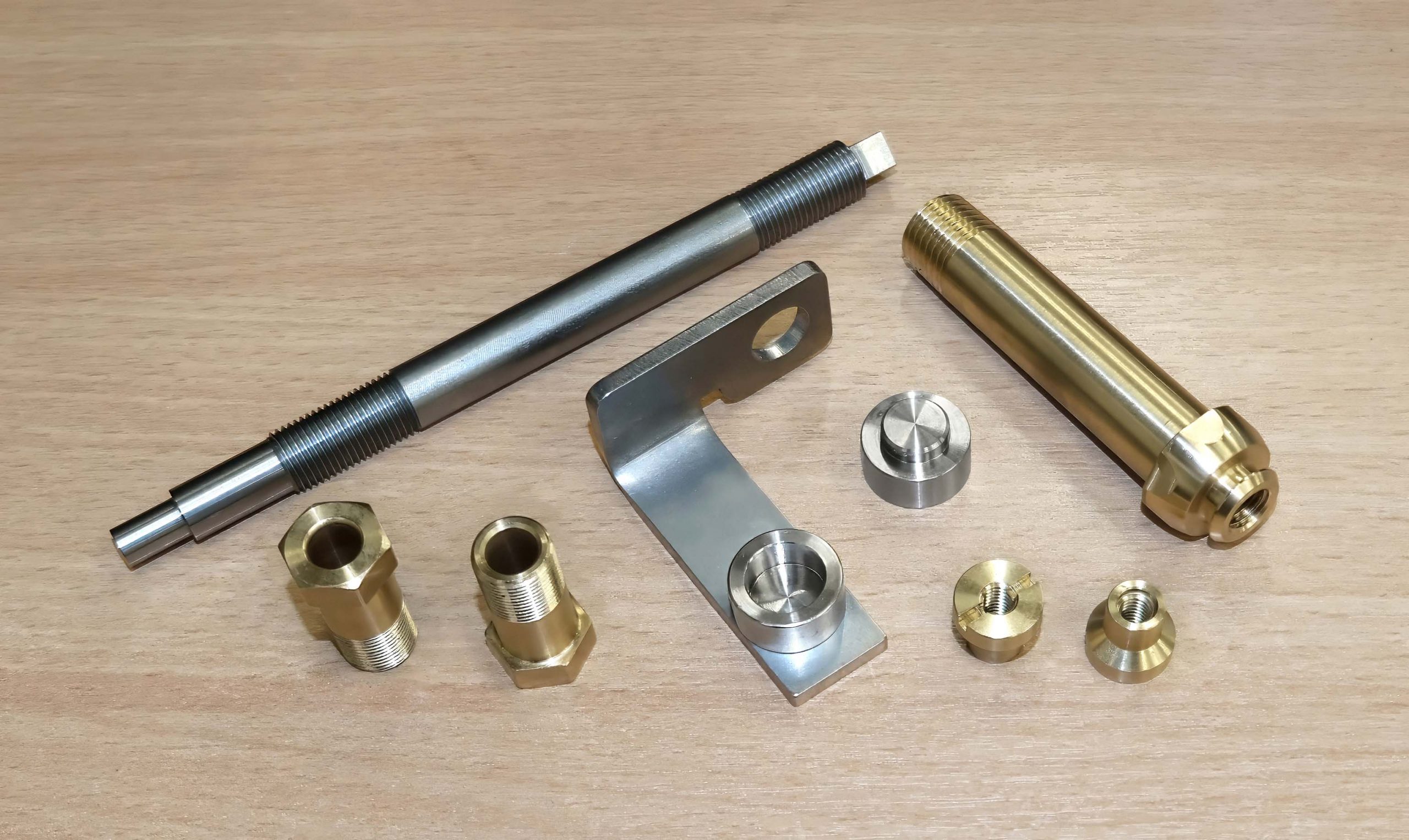
The components produced so far by TAS Engineering on the Cincom L20. The fabrication including the turned magnet holder is pictured centre, with a separate magnet holder inverted nearby.
TAS Engineering is currently undergoing a metamorphosis whereby, while fabrications will continue to play a part in the business, in the future it will only be if they undergo prismatic machining or contain turned parts. Already this policy has seen the contribution of chip removal, mostly metal and but also plastic, in the factory rise from 10% to 90% of turnover. It is a progression that was accelerated by the Covid pandemic, when on-site visits to provide customers with fabrication services were forbidden.
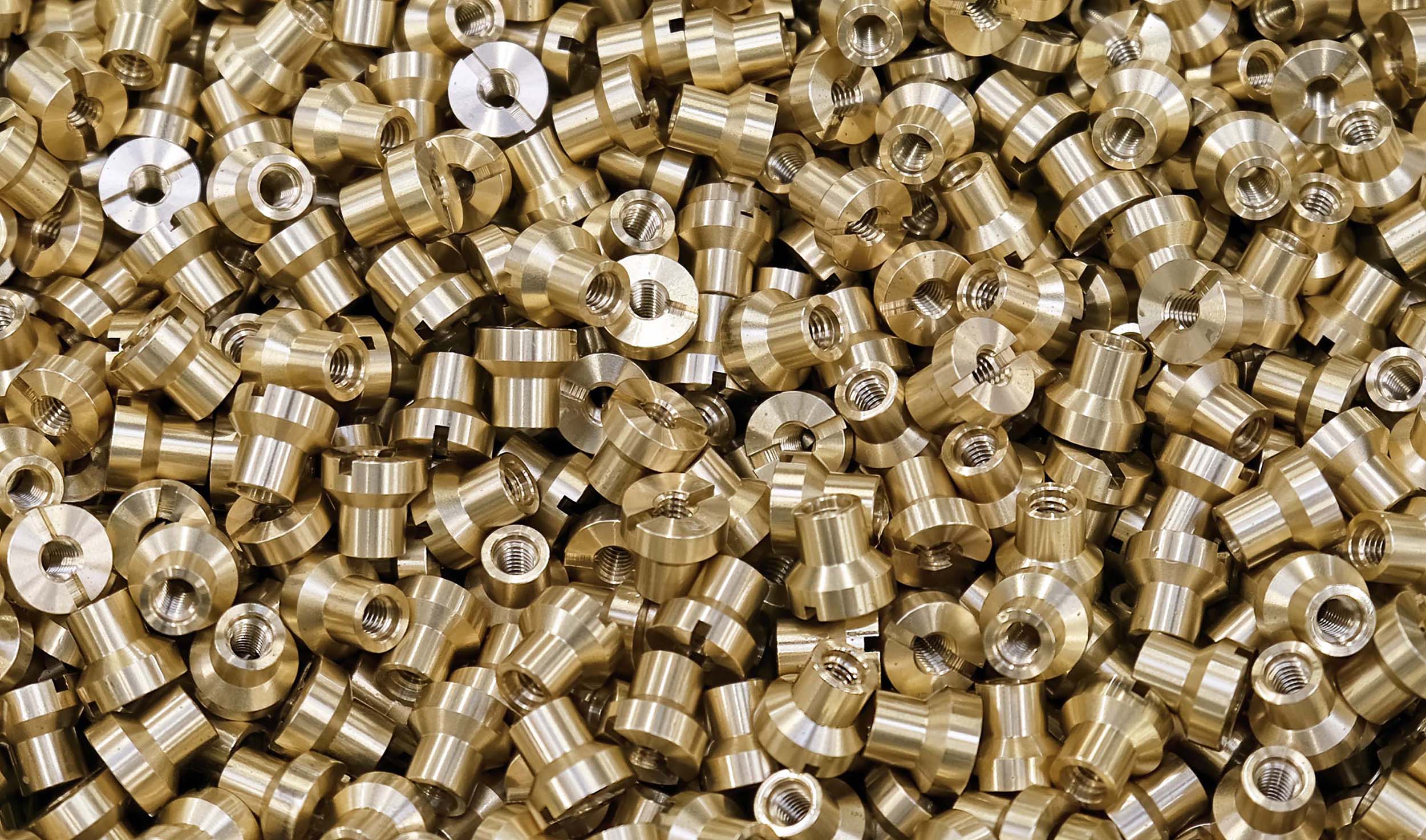
A batch of heritage railway carriage brass fixing pins.
Another insight offered by Mr Davies is the formidable financial advantage of purchasing a good quality used machine tool, provided that one can be sourced, which is not always easy. His L20 had only 40,000 hours on the clock when it arrived, equivalent to having run for a single shift every weekday. It is notable that, for the jobs completed so far, repayments on finance for a new Cincom would not have been viable.
On the other hand, paying back only one-quarter of the amount puts TAS Engineering in a strong position to quote for work very competitively, especially if it is not especially complex. Moreover, small quantities are also practicable, provided that the machine can be set up quickly. Mr Davies often uses Citizen’s Alkart Wizard software running on his laptop to speed programming and downloads the code to the control. Applications engineers at Citizen Machinery UK are always on hand to assist when needed. A recent instance was when Mr Davies was worried about possible damage to the steel engine shaft as it was ejected from the sub spindle. Within an hour, a response was received advising him to omit an M-code at the end of the cycle and replace it with a specific line of alternative code that worked perfectly as soon as it was implemented. “Such after-sales engineering back-up is invaluable, especially if you are new to sliding-head turning,” he concluded.
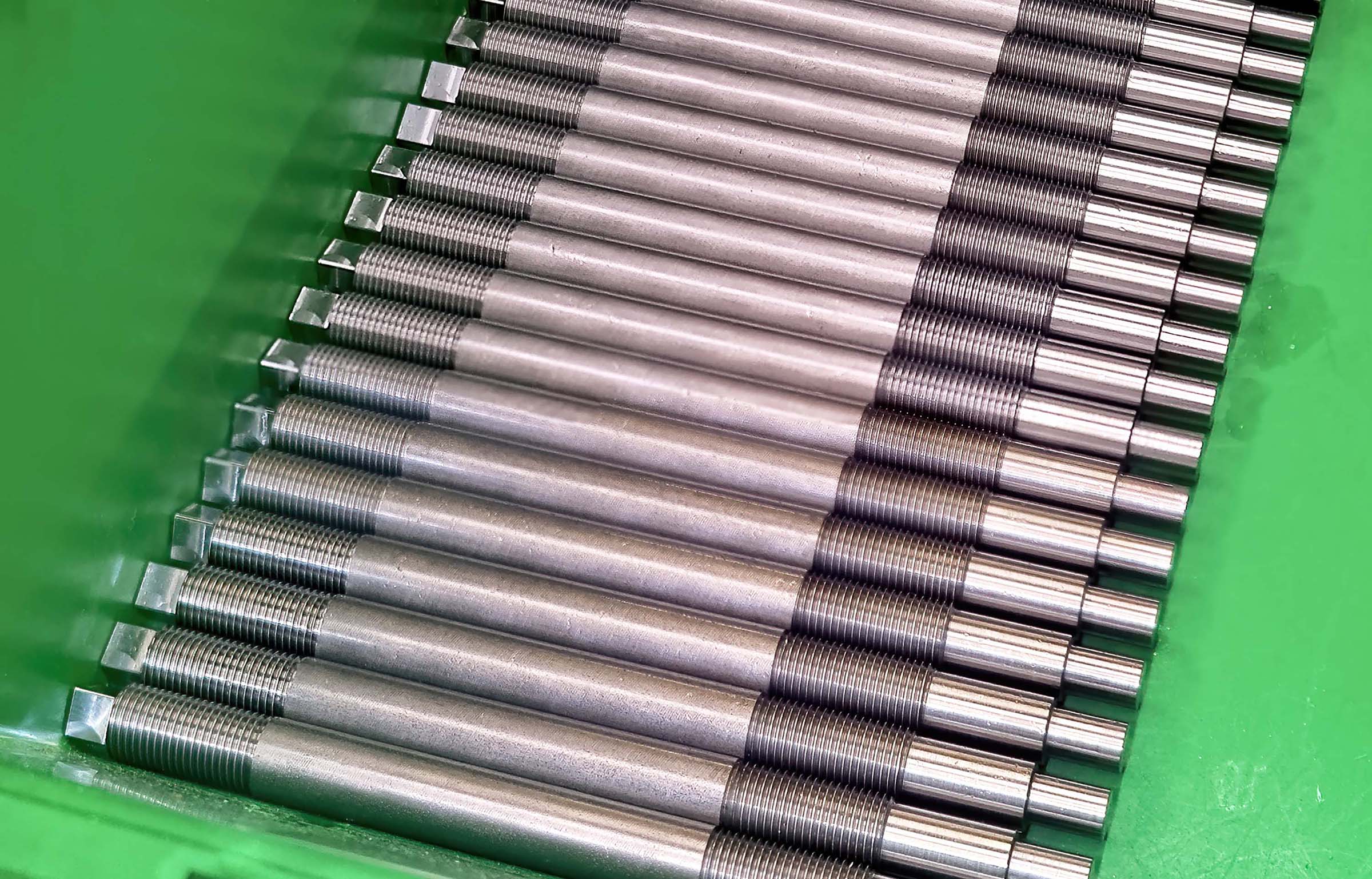
A batch of machined steel engine components.
SEVEN OPERATIONS DOWN TO TWO VINDICATES SECOND SLIDING-HEAD LATHE PURCHASE
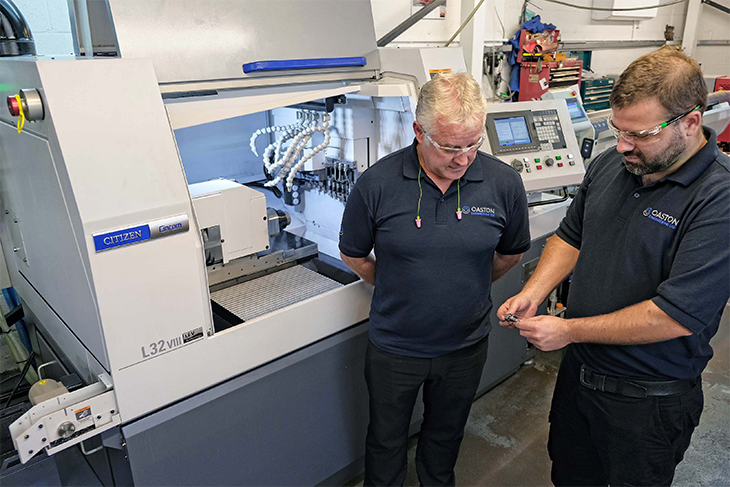
It is only within the last five years that Nuneaton-based subcontractor Oaston Engineering, which specialises in work for the aerospace and biotechnology industries, has embraced sliding-head turning, although it has used numerous fixed-head lathes since the company was formed in 1988. July 2018 saw the arrival of the firm’s first sliding-head lathe, a 20 mm bar capacity Cincom L20-VIIILFV from Citizen Machinery UK. It was followed in October 2022 by a second, larger model, a 32 mm capacity Cincom L32-VIIILFV.
Oaston Engineering’s managing director Sean McCarthy commented, “We were always led to believe that sliding-head lathe operation was a dark art and that you need to produce large batch quantities, say 50,000, to justify setting them for a new run. We had been looking at the technology since MACH 2008 and a decade later, when the Cincom L20 was delivered, we discovered the myths were untrue.”
He found that setting the machines was quick and so also was programming using Citizen’s Alkart CNC Wizard. It has a built-in library for machining processes to reduce the amount of time spent typing in G and M codes, together with internal reference material and diagrams to guide the programmer. The subcontractor’s setter / operators also frequently refer to the machine manual, which McCarthy describes as excellent. In the first few weeks, Citizen’s applications team provided help with preparation of the initial programs.
The ease and speed with which the lathe could be prepared for the next production run meant that batch sizes of as low as 200 are economical to machine. As it happens, though, the quantities the company is being asked to produce are steadily rising. One example is a contract to mill nuts and olives for an aircraft de-icing equipment manufacturer. In 2008, the typical annual quantities required were 2,000 and 5,000 respectively, whereas today they are five times higher. Both components are now machined on the L20, with typically parts for five months’ supply produced and consignment stocked to save repeated machine set-ups throughout the year.
Mr McCarthy continued, “We have always known that continuous investment in modern plant is essential to remain competitive in a global marketplace and we invested £500,000 in new plant over a 12-month period alone in 2022 to 2023.
“We had a strong competitor in Poland vying for the de-icing equipment contract, but the efficiency with which the L20 produces the parts puts the business out of their reach.”
He added that when it came to selecting which make of slider to buy, they carefully reviewed different suppliers’ offerings. Two factors swayed the decision towards Citizen Machinery. One was the availability of the LFV (low frequency vibration) chipbreaking function in the Cincom control’s operating system. The other was the knowledgeable response to questions, evidenced by the Citizen sales engineer being able to provide all answers on the spot, rather than having to refer back to head office every time. As Oaston Engineering was new to sliding-head turning, this was a major advantage.
It was also notable that the machine supplier was the only one offering to deliver the lathe with a bar magazine that was two metres long, rather than the more standard three or four metres. This was also important to the subcontractor, as space is limited on the shop floor and there would not have been room for a longer bar feeder.
Of the work put onto the L20 since it was delivered, 95% has been to fulfil aerospace contracts. One of the first jobs was a 303 stainless steel inlet connector, which came off complete in one hit in 3.5 minutes. Previously, four separate operations were needed. The part had to be turned on a lathe in a 3.5-minute cycle, transferred to another lathe for a second, 3-minute turning operation, undergo a 2-minute manual operation and then have a hole drilled on a milling machine, taking 1.5 minutes. Transfer between each stage took about 30 seconds.
The overall floor-to-floor time was 11 minutes 30 seconds, more than three times longer than on the slider with its very quick gang toolpost motions. The new process route allows a considerable saving to be made in the cost of production and the parts are perfect due to the absence of tolerance build-up through having to repeatedly clamp them. It enables the subcontractor not just to hold the price of the component to the customer, but to actually lower it by 5%. As is commonly known, cost-down is a widely sought throughout the aerospace industry.
According to night shift supervisor John Shirley, a substantial further saving is made in the cost of tools. Owing to the rigidity of the Cincom lathes and their use of neat oil rather than a water-based coolant, cutters tend to last a lot longer. For example, for the above job an HSS (high speed steel) twist drill only managed to complete 100 pieces before it dulled, whereas Mr Shirley finished a batch of 4,000 on the slider using the same tool and it was still sharp.
The LFV function is also proving valuable. It is used on most jobs to assist breaking stringy swarf into shorter chips, preventing entanglement around, and damage to, the tool and workpiece. LFV, which is switched on and off automatically within the program, is used sparingly as the microsecond periods of air-cutting due to the tool oscillation that creates the chipbreaking action also diminishes very slightly the metal removal rate. Nevertheless, its advantages far outweigh this small effect, especially when cutting oxygen-free copper, 316 stainless steel, aluminium (often 6082T6) and plastics including PEEK, all of which tend to generate bird’s nests of long swarf.
The Cincom L32 would have been purchased earlier had it not been for the pandemic; it was delivered by Citizen Machinery in July 2022. The subcontractor had a particular job in mind for it – the production of a light aircraft pump camshaft from 431S29, a martensitic stainless steel.
The component, which is produced from 1.25-inch bar, formerly needed seven separate operations: outside diameter turning and grooving; milling on a machining centre; two separate turning operations in offset fixtures to machine the cams to a dimensional tolerance of 0.07 mm; drilling a longitudinal bore on a machining centre; cross drilling a tooling hole in another operation; and off-site grinding of two spigots to within 0.015 mm.
The camshaft produced in this way required a total of 18 minutes 30 seconds of cutting time, plus inter-machine handling as well as 30 to 60 seconds for deburring and more time for inspection at each stage, all of which added up to several more minutes per component. Now, six of the operations are performed in one hit in less than 15 minutes on the Cincom before the part goes out for grinding. It had been hoped to complete the latter operation in-cycle as well, and indeed it was demonstrated that it is possible to turn the spigots to within 15 µm on the L32, but it is a tight limit that needs care to achieve and would have slowed production.
More than 20 jobs have already been through the L32, which is also fitted with a two-metre Iemca bar magazine and standardised to the use of 30 mm diameter stock to avoid having to change collets. Some work has been transferred from the L20, easing the pressure on that machine. The sliders operating in tandem provide security should one be out of operation. Mr McCarthy stresses, however, that neither Cincom has gone down since they were installed, which is a refreshing change from other lathes on site that are considerably less reliable.
Many components need hexagonal flats, but hex bar is never used as it would cause vibration and not be commensurate with producing accurate parts for aerospace and biotech. In any case, the driven tools on modern Cincoms are so powerful that milling of spanner flats is rapid. Oblique cross holes are required in that area of many components and to prevent the drill wandering, the milling is completed afterwards. Both Cincoms run continuously from 6.00 am on Monday to 1.00 pm on Friday, with night shifts always attended due to the nature of the work carried out.
The two sliding-head lathes not only hold the limits asked of them but are also highly productive, so much so that time has been freed up within the factory to begin assembly work for the first time. From November 2023, the body for the aircraft pump will be milled on one of Oaston Engineering’s 5-axis machining centres and assembled with five other mechanical parts produced on the shop floor, including the camshaft, before delivery to the customer. More such added-value contracts are expected in the future.
SUBCONTRACTOR’S TURNOVER MORE THAN QUADRUPLES IN THREE YEARS
Historically, a majority of subcontractor Reginson Engineering’s turnover came from the aerospace sector, with oil and gas generating most of the remainder. So, when Covid struck in early 2020 and aerospace contracts dried up, the Nuneaton-based, AS9100 accredited, Rolls-Royce approved company was deeply affected by the contraction in business.
It was mitigated somewhat by the company joining the Ventilator Challenge UK. During April 2020, Rolls-Royce asked Reginson Engineering to manufacture 113,000 components in 10 days to support the build of 8,000 ventilators. Towards the end of that month, within 36 hours of an order being placed for a pair of Cincom A20-VIIs sliding-head CNC turning centres to enable the medical contract to be fulfilled, the machines were delivered by Citizen Machinery UK. Both have LFV (low frequency vibration) chip-breaking capability, which not only improved swarf control, raising reliability and reducing the need for operator intervention, but also enhanced the surface finish on components.
The medical work was only temporary, however, so the family-run business owned by Steve Hatch set about finding business elsewhere. What transpired altered the company’s fortunes entirely, as a contract from a jewellery manufacturer combined with strong growth in aerospace conspired to increase turnover so dramatically that by 2023 it was 447% higher than before the pandemic.
Even better is to come. The jewellery company is so pleased with the quality of the mainly titanium jewellery pieces already supplied that it has signalled its intention to increase the annual quantity of parts from 100,000 to 1 million per month over the next few years. The machine tools underpinning both the quantity and quality of the jewellery parts produced at the Nuneaton factory are yet more Citizen Cincom sliding-head lathes.
Reginson Engineering is a long-time user of these Japanese-built sliders dating back to the early 1990s. In October 2020, the lathes were joined on the shop floor by the subcontractor’s first Citizen fixed-head model, a 64 mm bar capacity Miyano ABX64-SYY twin-turret, twin-spindle turn-mill centre. The user describes the machine as being fantastic, as it has allowed cycle times to be slashed compared with using other turning plant on site. Shortly after its arrival, it more than halved the cycle time for producing a component from 4 minutes 30 seconds to 117 seconds complete.
The upturn in throughput generated by the jewellery contract required much more sliding-head capacity, so the subcontractor has bought 14 new Cincoms in the last couple of years. They are seven 20 mm bar capacity A20-VIIs and the same number of 12 mm capacity L12-VIIs. Twelve of them are devoted to jewellery component manufacture and the other two were acquired to boost production of smaller aerospace parts. The latest influx of new lathes plus the recent purchase of two new 5-axis machining centres brings the total number of CNC machines in the Nuneaton factory to nearly 100.
Machine shop manager and family member Tom Hatch said, “We chose twin-spindle sliders for the jewellery work because positioning cutters on gang toolposts for the next operation is much faster than indexing turrets in a fixed-head lathe. It means we can produce components more quickly, not only because there is less idle time, but also because there is more scope for reducing the number of second and subsequent operations.”
He added that the machines are easy to set and operate, to the extent that he and one other staff member run 12 Cincom’s located in an adjacent factory unit that has been leased recently for the new project. The finish of the turned surface achieved on the lathes is 0.2 µm, which lessens the amount of polishing that has to be done in Nuneaton or by the customer.
Similarly, the performance of the Cincoms when producing aerospace parts is excellent due to the extreme rigidity of the machines, despite having to cut materials ranging from tough nickel alloys to titanium and stainless steels. Tolerances down to ± 3 µm are often turned, saving the time and expense of grinding parts in another operation. Surface finish is also high at up to 0.8 µm when required.
Reginson Engineering additionally runs UPR, a subsidiary company in Pune, India, which it set up in 2014. The facility has more than 20 CNC machines and 60 employees, enabling the firm to offer low-cost components to customers worldwide, mainly in the aerospace, wind turbine, medical and oil and gas industries.